Thursday, November 12, 2009

Birmingham PCT's Develop Mental Health Social Inclusion Enlightenment Compass

.


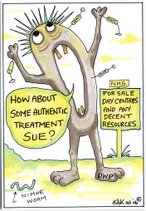
In talks with Mr Buddha and extremely truthful Mental Health Service Users Birmingham Primary Care Trusts have developed a fantastic aid to realistic thinking for MH Users ..It is rumoured the Dragons Den business crowd are interested too .

The New Social Inclusion and Enlightenment Compass spins around energetically and appears to create many directions of activity . In reality it goes nowhere and points to very little ..

However this is being used through G.B.T. (Gymnastic Behavioural Thinking ) to be realistic about the experience of despair that Mental Health Users have continually over services ....Useless services of course that do very little and over which there is no Patient Choice can hardly create MH Users confidently moving forward in life but that does not matter according to Mr Buddha ...

"Everyone has to face the void and the NHS mental health services are pretty empty really especially of emotional solution and human empathy and have often used up the Karmic wheel-of-life energy of Users and even created silly careers for some .

Now MH Users can sit at home and realise the waste of the last 10 years and yet become wise ... Maybe even campaigning with renewed fiery rage to create real choice and real services that provisioning bureaucrats can give up their jobs for ... "

"Service creation schemes will create Jobs when MH Users in the community determine the shapes of their long terms recoveries through real health care vouchers or budgets "

Mr Buddha who once suffered from illusions added :

"The top commissioning staff I have spoken too at the Birmingham Primary Care Trusts are glad to release into the market a jolt of compassing realism for miserable MH Users ..

Some top staff at Birmingham and Solihull Mental Health Foundation Trust are scowling now that some Users have the enlightenment compass even though those staff have recently returned from a world class cruise taking Governors and chosen staff with them to examine global social inclusion ..All for patient's benefit of course . "

.

Saturday, November 07, 2009

Did West Mids Police Advise MH Drug Blogger On Blog Tactics ?

.


USERWATCH FEATURE ....


Another strange story emerges from UK survivors . The last time we reported about alleged date rape of UK parrots we saw a blogger on UKSurvivors had used posts from Uksurvivors to claim they had been accused of date rape when it was clear it was the fantasy parrots and pirates that had been doing the dirty , or flirty or whatever .....There was quite a flap caused though

Wellllll....UKSurvivors ....Ahhh welllll yesss .. It issss a mental health forum, and wonderful beastly imaginings do go on there.

There are posts about snakes and fire creatures we hear, and death moans of socially excluded ghosts that waft in and out of flats and others that go around and around in circles and repeat themselves endlessly ..... It is said that many other ghosts of old text at UKSurvivors actually beg for eviction or deletion ....

However nowwww, there appears to be a half claim of some kind of communication with the West Mids Police. Noooo its not spiritualism ... Its something else though ..

It appears to amount to some kind of alleged nod of agreement or "implied police blog advice"

Oh yeahhhhhh ...Really ? They've gone from the Bobbies to the Bloggies then ...

Here's the post :


Drug Blogspot West Mids police ref


What we see in that Seroxat growling blog is a strand of some good argument about part of the SSRI diversion of the human condition into the meds-pit of delayed reactions and part voluntary emotional unconsciousness .. Yes, all done by "professionals" on the hapless patient in mental or emotional distress ..... "Bugger your social history and family problems etc... take a drug .. "

The blog favours growling about Seroxat - that's where a class action is going which it supports and compensation is the golden bone in its teeth .......

Yet the conflict between personalities it features is sparky in the meds-bulldog-pits too at Uksurvivors, though there is an argument put forward which is, Seroxat may not be the worst SSRI for its after effects after coming off it . In that case the class action planned to do it down and get compensation from the maker GlaxoSmithKline may fail since the action appears to framed in such a way that Seroxat is being legally tested as the worst case SSRI scenario ....

Is Jeremy Bryce who supports that argument and who is mentioned in the blog quite right therefore to create a contextual argument of caution regarding that ? Its an intelligent point we think ..

It could well be that he has a thought out serious point which implies jeopardy to further cases for compensation against SSRI's if the Seroxat case falls ...

Who knows what fate will bring ...... The Money king or the sting ?.... That's in the hands of future law.. But caution should be heeded ..

However that aside we have been sent a picture from a polite source which confirms the West Midlands Parrot Flying Squad cannot take the fiddamen.blogspot claims about them seriously..


.

Surprise Film : Death Of A Top NHS Staff Rat ....

.

USERWATCH COMPLAINTS PROCESS

RESOLUTION 1004#zc


A lack of cheek on Userwatch has been noticed by readers who have complained at our lack of pisstaking .. Sorrrrrryyyyyyy .... We aim through our complaints process to put matters right and to restore the level of your previous UserWatch service....

Lately we witnessed the death of a Top Staff Rat ....Get yer popcorn out for the film below and tissues for weeping ..We cried and shook ... All heart - is what we are .. We understand the film is dead-icated to Birmingham and Solihull Mental Heath Foundation Trust - and other trusts like it ..

And that poor autonomous long lost ghost named "Patient Choice"


Thursday, November 05, 2009

CAMHS Bed Days Statistics Nov 4th 2009

.

Click to enlarge image

.

Sunday, November 01, 2009

Sent To UserWatch And Others : The User Led UK Wide Personality Disorder Spectrum Survey Report

.


The User Led U.K. Wide
Personality Disorder
Spectrum Survey Report 2009


EXTRACTS :

Downloadable too from either:

Introduction.

The U.K. Wide Personality Disorder Spectrum Survey evolved from N.H.S. Service User's (patients) concerns and it is a User-led initiative. It is run entirely independent of political persuasions , State services, using voluntary effort, and at no cost at all to the taxpayer . The survey tool is hosted and been kindly donated for use for the P.D. Spectrum Survey by the Socialist Heath Association.

The National Association For L.I.N.ks Members (N.A.L.M.) which serves to create communication and common purpose for some parts of the UK roll out of Local Involvement Networks has kindly promoted the UK Wide P.D. Spectrum Survey.

Within its capture “spectrum”, and on advice from N.H.S. Service Users, it has focused on the experiences of service delivery within the N.H.S. regarding conditions of Personality Disorders (P.D.) that may be co-existent with: Borderline P.D., Post Traumatic Stress Disorder (P.T.S.D.), Complex P.T.S.D. and Dissociative Identity Disorder (DID).

In 2009 some questions arose amongst P.D. spectrum Service Users, through contact in online forums, and in the digital community, regarding how satisfactory U.K. N.H.S. Service User's experience of services actually now were.

Certainly many Service Users stated they were concerned about each other’s fates : the high rate of suicides, and depth of distress and poor treatments in the wider P.D. spectrum community. "New Horizons" the Government's current consultation of mental health U.K. services reflects those issues of concern too : -


On page 72 of : "New Horizons", the Government's July 2009 Discussion document, the prevalence of P.D. linked suicide is discussed :


One Personality Disorder online forum called : "J4K" (Justice For Kate) run by Phil Lockwood a volunteer advocate, and its "admins" , felt more had to be done to measure what was happening "out there" in the U.K. P.D. spectrum community, especially as that community is at high risk from suicide .

Consultations with forum Users on the "J4K forum" and with others, led to the idea of a fairly-structured start-up User-led survey to capture what was happening more widely. Who is experiencing what ?

Has for instance, the National Institute of Clinical Guidelines (NICE) and other work commissioned by the Department of Health to stop excluding treatment of P.D. Spectrum Service Users been useful ?

Is there evidence of better P.D. spectrum community inclusion now? Better outcomes for those with related Borderline P.D. ? And indeed other parts of the P.D. spectrum like D.I.D and forms of P.T.S.D. ?

From Page 72 of New Horizons :


Its clearly now worth testing these past years of intentions to see where effective practice has embedded in the UK , or not, up to this date . Let's trust the "patient" to speak through the survey . Lets form the User-basis of some continuing measurement for the P.D. spectrum community .

The agenda too within the U.K. Wide P.D. Spectrum Survey initiative is that of spreading positive User-Led self-empowerment, and ownership of the means to capture information and to archive it at low cost . It's an important consideration for the usually all too dis-empowered User.

The rights too , to create influence, and a more direct voice based on ideas of User-Led practice and of good data capture is important .

New methods of communication online have opened up democratic possibilities of social and Patient-Service-User action, together with the ownership over those actions.

Facebook P.D. groups , P.D. and BP.D. Blogs and BP.D. Forums , emails and Skype and texting are all creating new social ways to focus concerns towards methods of better capture of the Borderline and P.D. community views . This context is what has already shaped the U.K. Wide P.D. Spectrum Survey . U.K. Users have a made a start in the process of learning and measuring the services (or none) actually impacting on them .


Paul Brian Tovey
Independent Mental Health Monitor


Current Social And Mental Health Contexts Sept -Oct 2009 :

Before the presenting the results, which trend strongly towards asking for better psychological talking therapies it is worth mentioning the media reports of late that show discouraging tragedy and trends in psychological therapy supply for all Service Users in the UK . The Daily Mail ran a story (26th Sept 2009 ) regarding P.T.S.D. and combat stressed soldiers (many of whom could easily classify as partly P.D. spectrum sufferers that have been affected by experiencing traumatic emotional extremes)

: "Assistant general secretary Harry Fletcher said: 'There is overwhelming evidence that support is not available of sufficient calibre when soldiers leave the service"


The Observer recently ran an Oct 4th 2009 article about the poor supply side of therapists planned by the Government in its Improvement to Access of Psychological Therapies programme :

"But the Observer understands there are now concerns about whether these targets can be met. The IAPT Expert Reference Group – the body that oversees the implementation of the programme – was told last month that only 400 out of the 3,600 therapists needed to run it are fully trained."


The "Advance Statement" "Suicide" by Kerrie Wooltorton a Borderline P.D. spectrum sufferer which involved the NHS not treating her, raises concerns about the right treatment in the P.D. Spectrum community and the wider community too. (see Telegraph 8th Oct 2009)

: "Miss Wooltorton had an incurable, emotionally unstable personality disorder and a history of self-harm, and had in the past been sectioned and admitted to Hellesdon Hospital."


These current 2009 media reports and concerns over quality of treatment of people with P.D. type spectrum issues in fact have partly echoed why the UK Wide P.D. Spectrum Survey evolved . A young woman Borderline P.D. sufferer named Kate Logan Aged 27 perished by suicide in 2007 the same year Kerrie Wooltorton a Borderline P.D. sufferer aged 26 drank her last dose of anti freeze .


Kate Logan

: "Even Kate's online friends all over the world were aware she planned to take her own life. But her family feel mental health professionals didn't do enough to prevent her taking a fatal overdose. After years of suffering from borderline personality disorder (BP.D.), Kate, 27, of Gower Walk, Gateshead, took her own life this month."


The Dept. of Health on Personalitydisorder.org.uk show a film which spells out the truth itself about BPD within the PD range and the survey upholds their view too - a frame from their film is shown below.


"We have produced videos to support the implementation of NICE guidance on Borderline Personality Disorder and Antisocial Personality Disorder."


PRESENTING THE RESULTS :

Image 8
Click on image to enlarge


The survey asked for age ranges and obtained 134 responses


Image 9


The results above arose spontaneously and showed the vast majority of NHS Users (102) answering the survey (76%) were female.


image 10


The survey gave Users of UK NHS services the chance to self attribute across a range of condition-descriptions because "P.D. Spectrum" means a co-existence of effects that does describe the range from P.D. to Borderline P.D. to other effects that often accompany each other even within one individual .

qu 4


This question above homed in onto NHS service linkage and treatment.

Image 11


This survey question above also homed in on actual treatment experience to try to establish the experience of NHS drug treatment, talking therapy, CBT , or Counselling treatment - to begin to look at this mix .


Qu 6

Of the 134 sample 13 skipped the questions above and the top answer at 55.3% was sometimes drug treatments were helpful although 24.8% did not find it helpful, but 14.9 % did find it helpful. Caution dictates that any form of U.K. talking therapy supply would not match medication supply however. The next two top figures of 24% were associated with psychotherapy in that it was either helpful or sometimes helpful. Psychotherapy had a low dissatisfaction figure of 6% .

CBT and Counselling obtained lower satisfaction figures : 15.7% "Sometimes helpful. And Counselling : "Sometimes helpful" 13.2% .

17.4% of the sample did not find CBT helpful . Only 9.9% found CBT helpful which was quite a low rating for satisfaction . Counselling fared a little better at 14% of those who found it helpful although an almost equal amount 14.9% did not find it helpful .

The Survey in its construction wanted to drill down to what people felt they needed and these questions were helpful to test that track of possibility . Qu. 11 was a deeper test of Users saying what they felt was qualitatively needed for their treatment experiences (in their own words) set by some of their experiences which we could indicate to some extent through the earlier questions here .


Image 12


Identifying NHS Trusts /Service Locations


Qu. 7 . above had 15 people skip it but 119 people answered . Those Trusts identified will be put at the end of the report so that we do not clutter the flow of the report here . More detailed information too will be made available to the Care Quality Commission .who inspect Health and Mental Health Services in the UK .


[See: How to contact CQC Telephone: 03000 616161 : enquiries@cqc.org.uk ]


Image 13


The survey approached people via their P.D. and Borderline P.D. forums and groups online (with some contact off-line too). It wanted to ensure it openly attempted to establish its User-sample's credentials of being linked to NHS services the above question helped that .


Image 14


Qu. 9. reflected the current context, and that of some years of policy planners and others talking about personalised budgets . It was felt this should be included, because the P.D. spectrum of mental health sufferers have rarely been included in Govt., or other bodies' conversations, about personalised budgets, where the acute psychosis sector seem to have given more resource attention something that was at least partly upheld by the Royal College of Psychiatrists in 2003 :

"It is perhaps not unfair to suggest that many, if not most, adult mental health services have become psychosis services, dealing with those who are suffering from severe and enduring mental illness. Personality disorders are common, and are also disabling conditions. "


Image 15


Qu. 10 . Above : A broad User satisfaction measure was included and a lot of dissatisfaction shown . The next two following questions though opened out for Users to state far more .


Qu. 11 . Below. What would you chose as a treatment and/or support
to help your problem (briefly state)


Image 16


Qu.. 11. asked Users open-endedly what they wanted in terms of choice of treatment and/or support :

NOTE. Qu. 11. Abbreviations : Service Users well acquainted with mental health services often used abbreviations to answer Qu. 11.


DBT means Dialectical Behavioural Therapy
CBT means Cognitive Behaviour Therapy
CAT means Cognitive Analytic therapy.
NLP means Neuro Linguistic Programming
EMDR means Eye Movement Desensitisation Re-programming


ALSO NOTE : P.D. Spectrum Survey Answers to Qu.. 11. about what people want - Each of the 109 answers below is an individual User's answer - a few answers reported below (less than five) had parts omitted purely for confidentiality where Users might accidentally identify themselves by giving too much personal detail .

1. DBT. Less childlike day centre activities

2. I'd choose a talking and feeling therapy based on hearing me and allowing me to cry and heal from time to time .

3. I would love to learn CBT and DBT skills, but have been told by my CMHT that the NHS no longer funds these.

4. Residential stay allowing time to focus on recovery

5. I don't know .

6. DBT

7. CBT and drug therapy

8. Worker that I can trust and talk to when I need to

9. Medication and Psychotherapy

10. DBT

11 DBT

12 Just long term special support with me in control not them

13. DBT, more involvement in my treatment. Group therapy. This treatment although needs to be time related in some sort of way would be more beneficial if it was offered for a longer period than it is currently.

14. I am currently on a waiting list for DBT but it would be good to have some better provisions in place for what to do in a crisis.

15. I'm not a good example. I've avoided treatment.

16. Some kind of long term individual therapy, probably not only psycho-dynamic but don't know what

17. Access to a drop in centre would help me to isolate less


18. Ongoing, consistent and encouraging support


19. CBT or DBT (Drugs have little effect)


20 . Stabilise the mood swings and the unusual feelings of paranoia


21 . long term one to one psychotherapy


22 Dialectical Behaviour therapy or Cognitive Analytical Therapy. But if fixed number of sessions need e.g. CMHT ongoing support and practice skills in 'real world' for a while. Prefer idea of talking therapies to drugs, though happy to take drugs to get me to a level where can interact properly with therapy


23. Counselling, EMDR, NLP.


24. DBT plus on-going psychotherapy


25. I think any support would have been good, after many years in the adult mental health system its only the past 3 years I've had a psychologist but no other support available.


26. long term therapy, better understanding of staff of Borderline P.D.


27. DBT/CBT but its not available in my area you have to travel (2-2.5 hours drive)


28. I'm really not too sure as I've never really been told about all the different kinds that are available. I'd like to participate in group therapy though as sometimes I feel I'm totally alone with this

29. I'm really not too sure as I've never really been told about all the different kinds that are available. I'd like to participate in group therapy though as sometimes I feel I'm totally alone with this


30. More understanding of the illness by Psychiatrists. G.P.'s all medical teams including nursing staff and ambulance crews

31. One to one talking therapy

32. Anti-depressants (can't survive without them!). ONGOING psychotherapy with a psychologist. I saw a psychologist regularly for several years, but when she retired she/the service was not replaced. Regular contact and building a relationship of trust and understanding was invaluable.

I also pay for private counselling, which has been good as it provides continuity of care. For me, I find that a combination of these treatments is working best, and probably any one of them on their own wouldn't be so successful

33. Specific specialised care co-ordinator. preferably someone who has experienced living with a diagnosis of P.D..

34. More availability of professionals who are trained in trauma/complex P.T.S.D. so that therapies are delivered by those who really understand the condition.


35 Long term trauma/Psychotherapy

36. I have chosen private specialist counselling as this was refused when my NHS psychotherapist died. I would like to see self-help groups set up

37 I would actually like DBT and CBT to be more readily available on the NHS the waiting lists are ridiculously long, and some area's seem to only provided drug based treatment.
38 Something more personalised, the therapy I experienced was very broadly based.
39 . Relational therapy and other holistic therapies.

40. MORE SPECIALISED GROUPS IN MY AREA

41. Personalised budgets, therapy of my choice

42. Therapy

43. Talking therapy mainly

44. Long term psychotherapy

45. CBT as possibly EMDT, I have seen it displayed

46. Ongoing DBT therapy, appropriate and well trained crisis team, practical help and support for my family and children
47 . Intensive attachment based psychotherapy and long term designated support worker in the community

48. Intensive therapy - not given in weekly droplets

49. Therapy, home support , work support , training, benefits stabilisation

50. DBT

51. I see an experienced counsellor / therapist privately. She has participated in much additional training and is providing me with the support and tools to move on, in a framework where there is no time limit.

52. I have recently started a therapeutic community

53 I feel that due to the complexity of P.T.S.D. (combat stress) my local treatment centre do not understand my problems.

54. Telephone support in times of crisis

55. Counselling / On line email support

56. A GP who knows what they are doing, asks the right questions, has good boundaries and has dealt with their own psychological issues. Counselling once a week with someone trained or familiar/worked with D.I.D. A self help library that acknowledges DID Manners, dignity, respect and empathy

57. Professionals to take you seriously, I personally need to be in hospital when i drastically relapse and should be admitted as soon as I-or they acknowledge how ill I am becoming, NIP IT IN THE BUD

58. Psychotherapy

59. When in crisis some form of short-stay respite centre, a place of safety from self harm/suicidal tendencies

60. Earlier appropriate therapy at the appropriate time.

61. I would like to try Dialectical Behaviour Therapy

62. Definitely intense group therapy. therapeutic communities where different approaches are used.

63. Would recommend DBT to others.

64. More face to face individual psychotherapy. I've started in group therapy and can't handle it. I don't think I'm going back. Also a CPN who I can have access to when necessary.

65. I would like more than just the 50 minutes therapy a week, as it is incredibly difficult to cope in between sessions. A stay in a designed unit or more therapy would be very helpful.

66. Group therapy helped me before (for 5 years until 2003) then had a bad relapse/breakdown/psychosis after a relationship breakdown. Was given 1-2-1 psycho dynamic therapy (awful...) and a year after that am again going into long term group analysis

67. A good therapist who deals with the exact problems of my symptoms. Possibly a regressive therapy to get to the root of my problems.

68. DBT -Dialectical Behavioural Therapy EMDR - Eye Movement Desensitization & Reprocessing

69. DBT

70. Therapy based on how I see myself and interact with people, work and leisure opportunities.

71. DBT and drug treatment

72. Help with coping with day to day living, help with feeling like I don't want to live,help with eating disorder,self image,lack of confidence,coping with life everything really!!

73. Difficult to say as also have bipolar disorder
74 Dialectical behavioural therapy.

75 . More crisis intervention - not just being told that because I have a P.D. then I cannot have access to the CRHT.

76. I have read that short term hospitalisation have very positive outcomes on BP.D. sufferers.

77. My own treatment and support that I can choose not the NHS or PCT

78. CBT

79. CBT & shorter waiting lists!!!


80. Because my needs were not met by the NHS, I sought out a private therapist. She is helping me a lot but it also costs me a lot of money. If the NHS paid for this treatment I would be able to have more frequent sessions and the length of treatment would possibly be shorter.

81. Psychotherapy/Counselling because I find it helps me to talk through my issues with someone. If I talk them through they seem to diminish in my mind

82. Anything I was only given drugs and a name of a group that i had to refer myself too..

83. A good therapist, a CPN who understands my problems, and a supportive psychiatrist.

84. A mixture of a personalised budget and active support from mental health team.

85 . Individual sessions with psychologist

86 . Long term psychotherapy

87 . DBT

88 CBT DBT

89 . I would treat the (C)P.T.S.D.. I don't know how. Perhaps long term psychotherapy and desensitization

90. Crocheting

91. Counselling

92. I'm not sure .. one to one support and group support .. which i still have not received .. also .. online support .. for when I'm feeling bad

93. Counselling when needed. Not just 6-10 sessions after a long wait

94. Psychotherapy (group and one-to-one) Art Psychotherapy Community support with practical needs

95 . Individual psychotherapy

96 . Stepps

97 . Regular contact with someone to talk to - i found my relationship with my CPN very very useful for me

98. Practical support as well as in depth therapy, and choice about what is available and what might best suit you. There should be a choice of psychotherapies, including DBT, CBT, IPT, Schema therapy and mentalisation. There should be adequate information about these and medications, prescribing and referral should be a collaborative decision between worker and service user.


99. I guess talking helps, but has to be with someone, a therapist, and who understands P.D., not a care co-ordinator

100. DBT, Structured programmes

101. 1:1 therapy not group therapy inpatient services when very unwell

102. Psychotherapy

103. I want DBT.

104 . Multidisciplinary- psychotherapy, support groups (facilitated), art/ drama therapy, occupational therapy, medication and social input

105. Just a personal counsellor might help me but nobody has tried to understand what I'm going through

106. I'm unsure I've not found good support (in my opinion)

107. Emotional Freedom Technique (EFT)

108. Nothing (sorry)

109. Therapeutic community , support for family members and partner . Keeping my psychiatrist who has just left

Question 11 FINDINGS


The 109 answers above in Qu. 11. can be rendered roughly into categories of what people feel
they want or is desirable for their patient preference . Categories mentioned of note were :

Cognitive Behavioural Therapy
Dialectical Behaviour Therapy
Therapy
Medication
Better special and personal support (Care Co-ordinator and Psychiatrist)
Group therapy
Crisis Centre Intervention
Drop In Centre
Neuro Linguistic Programming an EMDR
Counselling
Understanding
Telephone support
GP support
Therapeutic Community


Image 17


This is a qualitative tool for understanding patient preference in Qu. 11. but the therapies together came out high with "therapy" coming highest with 34 mentions, and DBT specifically mentioned 27 times . CBT was mentioned 10 times. Some Users wanted special or better support from a mixture of Care Co-ordinator , psychiatrist and others and that was mentioned 18 times . The general trend of the opened ended section was towards more therapy and good ranges of human support and human understanding .

Medication (drugs etc. ) was only mentioned 5 times . This stands as a contrast somewhat, because quite clearly though the supply side of drugs is readily available as Qu. 5 showed (109
people experienced being supplied medication ) the trend in Qu. 11. pointed towards the needs for therapies and human intervention more .

Question 12. Below :

"If there are problems in your personal treatment/support experience of the services locally to you can you state what they are concisely? "


Image 18


Question 12. above was put and the opportunity given to Users to answer it open-endedly. The views which follow shortly are User's own words about their experiences of the Personality Disorder spectrum of UK NHS mental health services and how they are often problematic . A handful of Users had no problems, the vast majority do have problems as readers will see.

Anonymity for Users was guaranteed by the survey as a pre-condition . Thus some Qu.. 12 answers have had potentially personally identifying details erased and appropriately altered to preserve sense. Where for instance NHS centres or other locations were named together with other cross referencing personal details then locational information was removed and replaced with terms that substituted, like : "(a location)"

If family member terms were mentioned : " Gran , Granddad , Dad , Mom etc." then the information might be considered as potentially identifying with other cross references too so a line has been taken to preserve confidentiality too and the word "relative" is inserted instead .


The Care Quality Commission (CQC) will have information from the survey that will not be made public but only on the same condition that it remains as data-sensitive . Confidentially must be preserved but where the CQC wishes to drill down into the information perhaps on individual NHS Trusts. That right will be given to them but with the ultimate caveat of patient-User confidentiality . The survey tool has no names of , or ways of identifying individuals itself .

In Question 12. 103 answers were given . 2 were not not understandable and that has been stated .

Service Users sometimes used abbreviations : "DBT" means Dialectical Behavioural Therapy . "CBT" means Cognitive Behaviour Therapy and "CAT" means Cognitive Analytic therapy. "CPN" means Community Psychiatric nurse and "CMHT" mean Community Mental Health Team .

Each separately numbered answer to Question 12. below, was an individual User's submission .


What The Service Users Said : Question 12 :

"if there are problems in your personal treatment /support experiences of the services locally to you can you state what they are concisely "


1..... Rude psychiatrist. No real explanation and shit cover apart from by my own CPN.

2..... They are inconsistent and poor at seeing my needs as well as giving me the help I feel I need - I just want therapy and to be heard empathetically and to manage my damage and to create a life that I can live with some real emotional help .
3..... Complete lack of options regarding recovery models. Lack of response, support, and on delivery of promises in several instances.
4......No personal service
5...... I am not offered any support with my local CMHT and having to look at out of area CMHT for much needed support
6....... I've only ever been offered a CPN to deal with present issues rather than some long term therapy to learn to deal with and understand the more deeper issues.

7.......Psychiatrists reluctance to prescribe meds. They should listen to what we need, as we know best.
8......Now have a social worker that I cannot relate to and don't trust to talk to.
9.....Have only been diagnosed with BP.D. 8 months but been diagnosed with lot of other things in the past and I have felt that since BP.D. diagnosis attitude of Psychiatrist Doctor etc.. has changed negatively toward me
10.....Just having to get appointment it is a long wait I have been waiting 9 months
11.....I currently have an in depth treatment plan, I see a CPN for counselling and support fortnightly, a psychologist for CAT weekly and a psychiatrist for review 3 monthly. It has taken a lot of struggling over an 8 year period and many hospitalisations to get this. However all of this is due to end in September a mere 6 months after it commenced. It has been indicated that at that time I shall be discharged from all services regardless of my MH state. Lack of communication, I have to inform my psychiatrist of when I've been to hospital.
12.... Often it has felt like there is little available in terms of prevention and everything is focused on picking up the pieces afterwards. I now see a psych liaison nurse occasionally but for her to see me is essentially above and beyond the call of duty. I suspect that past crises could have been avoided if I had received support I needed to sort myself out before things got too much to handle.

13...What services?
14.....The only treatment they offer me now apart from drugs is group therapy which I'm not sure is right for me but they say there is no more individual treatment available for me
15.....No support from secondary services is allowed because I am encouraged to manage on my own, regardless of how bad I feel. I was turned down for a social worker when I hadn't opened mail for a year and was about to be evicted, which resulted in a suicide attempt and a month in hospital.
16......Inconsistency & changes
17.....Major failure in several aspects....Sending letters to wrong addresses, not taking my condition seriously :(
18....A lack of communication and understanding of the disorder or a lack of willingness to want to understand!!! Lack of crisis intervention and respite care short term.
19.....Not being taken seriously, being discharged when in severe need of help.
20.....Despite direct referral from England CPN to Mental Health services here (6yrs ago), have only just got a CPN in last 6 months (different system, & fell between 6-wk/short-term CPN & not fitting 'tick boxes' for longer-term). Have had consultant, but deteriorated without support. Long wait (told 1-2yrs) for DBT/CAT, but haven't been referred for any therapy anyway yet. Not aware of a care plan/where things are going but have asked. Crisis calls (even from GP to psych emergency team) met with 'yes you need help' & referral back to GP or no response. Subsequent suicide attempt considered 'impulsive'. CMHT hours recently cut back and no longer cover anything out of working hours (problem as have job although currently off sick, & cover teams obviously don't know you)
21....I wasn't told of my diagnosis, despite having other issues every service is wanting me treated by the P.D. branch, I do not agree with the diagnosis of BP.D. as I do not have the required symptoms but I was never given the opportunity too challenge or even discuss the diagnosis, I only learnt of it when the crisis team were involved and the received my care plan through the post.
22....There is no psychiatrist working within my area who has an interest of specialises in P.Ds. I go private to a facility so I have to pay once a month to see a psychiatrist there who oversees my care and takes charge of the prescribing
23....My CMHT do not offer support to people with BP.D. they see you as time wasters, they've refused me support many times when I find the courage to ask for help, its so awful being turned down time and time again when you find it hard to ask in the first place
24.....No specific P.D. service, think something was started but not heard any more

25......Waiting lists to start group therapies etc. are a huge problem and lack of support groups within my area
26.......CONTINUITY OF CARE: I moved home a year ago but have not changed my GP (despite the inconvenience) because this would mean that I would also have to change my CPN, even though the CMHT that I'm under is closer to my new address. It has taken me a lot of time to build a relationship/trust/understanding with this professional and I couldn't bear to have to lose that and start all over again, simply because I've moved down the road a few miles. Before I had the diagnosis of BP.D. I was labelled a sufferer of clinical depression and was seeing a psychologist over a period of 5 years. When they retired, I was not offered any further support until I had another crisis - this left me feeling rejected and abandoned (one of the symptoms of BP.D.!). The psychiatrists at my local CMHT are constantly changing and with many of them you have a sense that they are dismissive of you anyway. The DBT that I receive is exceptional and I am very lucky to be able to take part as my inclusion was purely down to geography. However, I have anxiety about it as it is a pilot project, so funding could easily be withdrawn and there is no other DBT available in the county.
27.....I have been discharged from the CMT, I only see my Psychiatrist every 3 months and she does not know much about support someone with P.D. and I can only see her every 3 months. My GP is not the place to gain support either.
28......Lack of expertise with regard to specialist knowledge of childhood trauma. Too much reliance on medication. Being passed from one person to another (as often not sure what to do with me). Easier access to services needed, as often no out of hours support. No access here to D.B.T either.
29......Not been offered therapy was referred by Psychiatrist but was turn down for being TOO well.
30......Dissociative Identity Disorder (DID) not widely accepted. Refused talking therapy twice after therapist died. Hospital admissions within own Trust problematic and traumatic. Lack of care and empathy. Crisis service will not respond to me
31......We have no Psychologist available, I have been waiting for DBT since February and I have been informed there is no chance of it coming any time within the next few months. My Psychologist appointments are infrequent every 6 weeks and it is very hard to speak to anyone if you need help with medication problems. Also I must add the staff at (a NHS Location I go to ) are very rude when you ask for their assistance. I have been yelled at, spoken down to and ignored whilst seeking help with my treatment and I have often been left for extended periods of time on medication that I have actually been allergic too and have been having quite severe allergic reactions to. Also local GP practice misdiagnosed me for years without actually referring me to see the mental health team and they seem to have no idea what BP.D. actually is.
32.......I had DBT which didn't really work for me, although I was told MBT would be more suitable nothing ever happened. It seems as if P.D. patients get forgotten about.
33........I just don't know what is available to me or how to ask.
34........NOT MILITARY ORIENTATED
35.........Medicalisation of trauma issues

36.........Sometimes have to wait for help and someone to talk to - this cannot be helped
37........Not enough trained staff for regular sessions. or staff have other commitments.
38........Therapy being time-limited. Not time to build up a therapeutic relationship. Relationship and therapeutic alliance is key to successful treatment

39........EX Forces
40........No one apart from specialist DBT therapists understand, are trained in or are at all empathetic in my condition, most workers would rather pass the buck, this has resulted in my being abused in many ways by many services
41........Being made to feel like a hopeless case, being told that my need for stable care workers rather than unfamiliar ad hoc care is unreasonable. not being seen as a person but rather as an attention seeking manipulative P.D. who does not have a valid mental illness and is unworthy of care and support.

42.........Disability discrimination from services

43.........The staff do not care & are blatantly anti P.D.. They are abusive & do not understand my issues. Especially at (two NHS locations given)
44..........All treatment offered was short time and only for superficial aspects (the depression / anxiety I presented with) rather than treating the underlying causes.
45..........I feel that I have not been listened to
46........(The survey omits this answer due to uncertainty of its meaning)

47.........Appointments too few and far between
48..........No diagnosis. Had to diagnose myself by searching "google" extensively when I could stay on task and then have diagnosis confirmed by an independent professional. P.T.S.D. as a result of poor and inadequate healthcare unable to access NHS services for any form of healthcare. Verbally, physically and sexually abusive practices by healthcare "professionals" and no accountability No dignity, respect or empathy - Blame and shame No training in chronic pain management or understanding of MUS Incompetent GP's - poor professional boundaries, blame and transference. "Psycho" Psychologist/ PMT/ stressed/ unsure but definitely not my problem Breaches of confidentiality Patriarchal attitude toward patients No understanding of trauma A desolate wasteland of poor resources, poor skills, inadequate training, stress, incompetence and hidden abusive practices without systems of accountability CPA written and given to you to sign under duress - Professional meetings without patient consultation - No choice - treatment enforced through coercive, abusive and manipulative practices No social support, no benefits - debt Pseudo university - where have all the professionals gone? Clinical trials on vulnerable patients without informed consent. Pursuing legal action
49........Professionals (or so called) have varied opinions, therefore no consistency, my care plan is rubbish and was done without my full input, in fact my CPN is not very good at all, I can not remember when last had a review, so (am on sec 117) have insisted on one
50........Too focused on medication and taking control away from me
51........Home treatment team totally inadequate, a and e support is poor, not given access to a psychiatric doctor when in a and e have to travel out of area for wider treatment available
52.......I was in the mental health services for years (on and off) I was never offered any type of therapy until 2005 when complex needs started in (a location given) I feel I was 'dumped' there because they had no where else available.
53........Many doctors treat you like there is no hope, there's nothing they can do for you.
54.........Recovery seems to be a problem. after finishing treatment, we are not given the right support to continue recovery that hopefully will enable us to progress back into society and work.
55........Time Limited Therapy and I don't think there is any DBT therapy available, .
56........My notes have been lost on numerous occasions, and there has been a catalogue of errors in my treatment resulting in almost 2 years elapsing since the police (helped save my life ) until I got treatment.
57.......(Two crisis centre locations mentioned ) I had to go to a place for suicidal people but once you've been there you cannot go there again. However my GP is very supportive, my Psychiatrist and consultant psychotherapists are supportive even though we might not always see eye to eye...or put it this way, when I'm in a bad state I perceive everyone is angry with me.
58.......The tablets are a sort of quick fix that the NHS give to you as there are huge waiting lists to get to see a counsellor or whoever you need to help you.
59........DBT & EMDR are not available on the NHS locally and I have had to request specialist funding to access therapy privately.
60........MONEY!
61.........The only option for intensive treatment has been closed down (Henderson Hospital).
62........They don't believe me and are reluctant to diagnose or prescribe very often
63........Unhelpful G.P's and rotation of psychiatrists
64........Don't understand

65.......When presenting with bipolar symptoms I have often been treated as "attention seeking". nobody listens.
66........DBT not available in the areas I have lived in (two locations mentioned ).
67.......The Crisis Assessment & Home Treatment Team refuse referrals from people with personality disorders meaning there is little, if any, out of hours care/support.
68.......I am attending group psychotherapy based solely on people with BP.D..
69.......Not the right treatment for me and having to go all over place to find a service it there are any

70.......The trauma was caused by an assault by a doctor on NHS premises. I have difficulty receiving therapy in a similar environment. Nothing else has been offered.
71.......I waited approx. 18 months to see someone when at (a location given) and ended up seeing someone privately, which put me into substantial amount of debts.
72.......I have encountered many negative experiences. Personally, I found once I was diagnosed with BP.D., I was then labelled as a manipulative, lying, attention seeker and nothing I said was then taken seriously. I was offered a place in a Therapeutic Community but unfortunately that is not suitable as I am currently a carer for my elderly relative. I also don't agree a Democratic Therapeutic Community would be helpful for me. I was told I was "too ill" for individual therapy and also that I would only become too attached to the therapist. So I sought out private therapy and have been going weekly for 18 months. Since then we have had to seek further help due to my dissociative problems and I have now been told I probably have Dissociative Identity Disorder by private specialists. However yet again my CMHT do not take my dissociation seriously so I feel unable to tell them about my alter personalities, as I know fully well they will either put me back in hospital and dose me up on more medication or worst still, they will tell me I'm making it up for attention. I feel I have been re-traumatised by the NHS system. As a child I was not believed when I tried to tell people about the abuse I was suffering. As a teenager and an adult the disbelief has continued and caused my mental health problems to worsen. Finally I feel I must add that my local 'Crisis Team' is a joke. I have been told "Why are you phoning us? we can't stop you self harming, just make sure you go to A&E if you do something serious" and after asking for a female worker "Why? what's wrong with me?". I have friends who have also had similar problems with the crisis team.
73......Access to the same psychiatrist was never possible I met a different one on almost every visit
74......Too many to mention
75.......There is no longer access to therapy for people with the diagnosis of P.D. since the DBT programme stopped because of lack of funding. I am lucky in that I still have my therapist.

76........CMHT not very helpful at all. Organised direct payments, but no ongoing practical support and unwilling to allow access to consultant psychiatrist. Care co-ordinator seems uninterested and unwilling to help. (perhaps through overwork...or an emphasis on psychosis in the service)

77.......Once been in system 5+ years services basically withdraw
78......Insensitive inpatient psychiatrist who just threw in the diagnosis in a meeting as though I knew all about it.
79......Not being listened to

80.......I don't think psychotherapy is readily available, they use medication too freely
81.......Fragmentation of service mean that no-one will talk to one another and no-one will take responsibility - buck passing.
82.......There are no problems
83.......Psychological, physical and neglect abuse.
84...... (The survey omits this answer due to uncertainty of its meaning)
85.......No crisis help. Misunderstanding of condition leading to prejudice / judgemental treatment.

86......Lack of service input because BP.D. does not fit into NHS boxes.
87.......Medication
88.......I have moved one mile out of my area and am having to move to another trust for care and this is causing a lot of stress for me - I spent a long time building up a good relationship with the team and feel that if the patient is prepared to travel for treatment then they should be able to remain with the care team.
89.......Negative staff attitudes and lack of knowledge and information. People have responded to me based on their assumptions about me rather than my actual actions or have known less about my disorder and myself than I do but are still not prepared to listen to me. I have had a potentially life threatening illness ignored and considered to be psychosomatic until I was in A&E on a heart monitor and oxygen with a very physical problem.
90......No help at all... given Seroquel and left to my own devices... found a drug counsellor on my own!!! she is the only person I see....
91......Just keep getting put on "therapy" lists, waiting lists, waiting for assessment lists, have had two care co-ordinators, both have been limited in what care needs they can fill. Was in a psychotherapy unit full-time for one year, should have been two. as I found it impacted so greatly on my general health I pulled out but I thought I was taking part, since that need wasn't recognised or followed up, and I believe it has been noted that I "wont/cant" (not my words) work with a.n.other, then there is a reluctance to offer alternative. has been suggested I take part in social and or other activities but no help been offered or supported for my mood management, anger, helplessness etc.. I believe I am more stable but they wont uP.D.ate my care plan, in fact I have no care co-ordinator working with me at present despite having complex needs. I have noted that I have a care plan with a crisis need but this has not been signed off on, I have a carer and we say his carer assessment is poor and have argued that his needs are not being addressed. we have moved from one County to another now for care and basically we are no further on other than to suggest we drop in to their link centre ?!

92.......Counselling only 6 appointments and that's it out the door. too many changes in psychiatrists during treatment
93.......Not enough access to get you back in to mainline society
94.......No offer of any 1 : 1 therapy

95......No problems
96......A certain Senior Psychotherapist has taken against me.
97.......Lack of understanding and treatment/ diagnosis/ assessment options. just been for tertiary assessment which has lead to same / more diagnoses and have new team at staffs of which crisis and the psychiatrist (only seen once so far) seem to be working but requires a lot of coordinating by my family and myself
98........Ignorant NHS people have just made matters worse and they have destroyed any hope I have

99.......Cast aside for being aware of my surroundings and questioning them. I was diagnosed last May (2008) with P.T.S.D. when I had a very severe panic attack. My partner drove me to an A&E, I was left in a small room with no support & unable to hardly breathe. I had to ask a passing Nurse for help, I thought I was about to pass out. The other Nurses were talking over the way in full view of me-talking about the previous nights television & ignoring my obvious distress. Then all I was offered was a drugs, Quetiapine gave me horrid side effects & I had to stop taking it.

100.....The CBT Counselling had an 18 month waiting list.
101......They tell me I'm being treated for things when I am not being treated for them. symptoms of crisis are not taken into account when having them. Care co-ordinator goes on about self harm a lot but takes no notice of committing suicide which I would have thought of as a worse symptom.
102.......Being told originally that I was too nice to have a Personality Disorder by a Dr. and being treated for 4 years for Bipolar Disorder

103.....No one has time to support..


Questions 13 , 14, 15, 16 .

The survey measured User Knowledge about the Care Plan Approach (CPA)


image 19


What was strongly indicated here above is there is a "CPA-application-lag" of those who knew about the Care Plan Approach above (64.9)% and those who actually had one (34.9%). These percentages need only a very slight readjustment to indicate a truer figure due to those who answered each question (Qu. 13 = 134 and Qu. 14 = 129) . Some 51 Users (38.1%) did not even know what a CPA was .

The issue of looking into this deeper becomes more pointed when two other questions (Qu.. 3 and Qu.. 16 ) are brought into this frame of enquiry : In Qu.. 3 , 72.4% of the sample (97 people) self attributed Borderline Personality Disorder to themselves as part of their cross-condition description.

In Qu.. 16 below the survey asked who had crisis plans, a care co-ordinator, and a CPA. Out of a 132 answers 59.1% (78 Users) said they did not have any of these . That is deep cause for concern .

Image 20


The NICE Guidelines on Borderline Personality Disorder issued in Jan 2009 "Management and Treatment" state :


Teams working with people with borderline personality disorder should develop comprehensive
multidisciplinary care plans in collaboration with the service user (and their family or carers, where
agreed with the person). The care plan should:

– identify clearly the roles and responsibilities of all health and social care professionals involved

– identify manageable short-term treatment aims and specify steps that the person and others
might take to achieve them

– identify long-term goals, including those relating to employment and occupation, that the
person would like to achieve, which should underpin the overall long-term treatment strategy;
these goals should be realistic, and linked to the short-term treatment aims

– develop a crisis plan that identifies potential triggers that could lead to a crisis, specifies self management strategies likely to be effective and establishes how to access services (including
a list of support numbers for out-of-hours teams and crisis teams) when self-management
strategies alone are not enough

– be shared with the GP and the service user. "


Qu.. 15 below demonstrates the need for continuing supports in the P.D. spectrum of Users if they are to be enabled to become self helpful , more functional, and socially included . It also shows how disabling the Personality Disorder Spectrum of suffering is .

Image 21


The NHS Trusts/Locations named
by each User. Question 7.

(the order has been randomised for respondent-confidentiality )


Surrey Borders NHS Trust - Epsom
Surrey & Borders NHS Trust, Stanwell, Staines
Dudley Mental Health Trust (Dorothy Pattison Hospital, Walsall)
MEDWAY PCT, CHATHAM, KENT
Sheffield Health and Social Care
Main House Northfield
Merseycare Liverpool.
Leeds partnerships NHS Foundation Trust
Castle Hill, Cottingham, Hull
Nuneaton, North Warwickshire MH Trust
South Essex Partnership NHS Foundation Trust
Bradford District Care Trust
St Georges
Carlisle
Bedfordshire and Luton Partnership NHS Trust
Oxford
Ayrshire and Arran health board
Laurel House, Canterbury Kent
North Essex Partnership, Chelmsford, Essex
Surrey and Borders Partnership Trust
South Staffs Staffordshire
Fieldhead Wakefield
Cassel hospital
Pennine Care - Bury, Lancashire
Worcestershire
Complex needs service. Tindal Centre OBMH/TVI
Lyme brook, Newcastle-Under-Lyme
Oxfordshire and Buckinghamshire Mental Health Trust High Wycombe
Worcestershire Mental Health Partnership Trust
Leeds
West Kent
2gether Foundation Trust Gloucester
no
Queen Margaret,Dunfermline,Fife
Manchester and Wandsworth
Maudsley
The Cresent in New Addington Croydon , Surrey .
Lancashire Care Foundation Trust
Main House - a residential Personality Disorder treatment in Northfield, Birmingham, part of Birmingham & Solihull Mental Health NHS Foundation Trust
Tyne and Wear, Newcastle
Hayards Heath, West Sussex
Princess Royal, Haywards Heath
Tolworth Hospital South West London and St Georges Trust
Royal Edinburgh Hospital, Edinburgh, NHS Lothian
Wallingford hospital, Oxfordshire...
Leicester and Cornwall and now Devon
Surrey, Dorking
Surrey border, Aldershot Hants
Buckinghamshire
St Leonardsgate Psychological Therapies Service St Leonardsgate Lancaster LancashireCare
Shropshire and Staffordshire foundation trust, SLAM foundation Trust
Nottingham mental health services
BSMHT
St Michaels Warwick
South Warwickshire PCT
East London
Birmingham and Solihull Mental Health Trust, Small Heath and Aston teams.
Leicestershire
Humber Mental Health Teaching Trust
Sandwell Health Authority - West Bromwich
Carters Lane House Shoreham West Sussex
Edinburgh, Lothians
South Yorkshire mental health trust, west Yorkshire
South London And Maudsley
Addenbrookes
South Essex mental health trust (Southend on sea)
Birmingham PCT North
Gateshead and South Tyneside NHS
Camden and Islington NHS foundation trust, London
Darlington
Bristol
South London and Maudsley MHT
Selby and York PCT (York)
Oxfordshire and Buckinghamshire Mental Health Trust
East London
West Herts NHS Foundation Trust Hemel Hempstead/Berkhamsted
Nottingham - Notts personality disorder network
West Suffolk CHP, then NHS Lothian.
Leicestershire
Oxford Ayelsbury, Lincolnshire
Conwy and Denbighshire health trust
North Yorkshire and York
New Craigs Hospital Inverness
CMHS fort william
Surrey and Borders NHS Partnership. Dorking
Royal Cornhill Hospital Aberdeen, Scotland
Haleacre Amersham Buckinghamshire
Cornwall and The Isles of Scilly
Derbyshire Mental health services Trust
Cassell Hospital London
Cardiff
Northampton
South West Yorkshire Mental Health Trust
Birmingham.
North Hampshire Partnership NHS trust Basingstoke
North East Wales NHS Trust
York
Northumberland, Tyne & Wear Mental Health NHS Trust, Newcastle upon Tyne
Lansdowne psychotherapy Clinic Glasgow
North Bham
North East Lincs, Grimsby
Crawley, West Sussex & Worthing, West Sussex
Lancashire Care Trust - Chorley
Wishaw North Lanarkshire
Wallingford hospital,Oxfordshire..
Lincolnshire Partnership NHS Foundation Trust
Monklands Hospital, Coatbridge, Glasgow-consultant Coathill Hospital, Coatbridge, Glasgow-psychotherapy .
QEPH Birmingham
Barnsley Community Mental Health Trust (North)
Dalston, Hackney, East London
Newtownards hospital McqQueens Department
Bootham Park Hospital, York (York and North Yorkshire PCT)
Bath & North East Somerset
South West London and St Georges Mental Health Trust
Cardiff NHS Trust.
Birmingham & Solihull Mental Health Trust
Bucks CMHT (Amersham/Haleacre Unit)
Maidstone Kent
Derbyshire PCT Newholme Hospital, Bakewell
Huddersfield- South West Yorkshire Mental Health Trust Hull
Finneston House Downpatrick County Down


The UK Wide P.D. Spectrum Survey

Broad Findings & Trends


This first User-Led U.K. Personality Disorder Spectrum survey has shown overall (Qu. 11. ) that there are significant unmet needs for talking type therapies and for personalised choices of that too. It has shown (Qu. 16) in part of the P.D. spectrum range a lack of NHS provision for good care planning in terms of crisis and Care Plan Approaches (CPA's). It has thus strongly indicated the Care Quality Commission should pay some special attention to measuring and inspecting U.K. mental health NHS provision of comprehensive Care Plan Approaches particularly in the Borderline Personality Disorder areas where unmet CPA needs exist .

It has shown there appears to be a large NHS over-emphasis on medication even in the face of new Jan 2009 guidelines re: Borderline P.D. from NICE . It has indicated there are lack of provisions for all parts of the mental health population namely : "The P.D. Spectrum" that is simultaneously at high risk of death by suicide. Any current evolving provisions such as the Improvement to Access of Psychological Therapies (IAPT programme) must be monitored, measured, and openly reported on and certainly with a P.D. spectrum set of critical User-"spectacles" on too.

The survey has shown (Qu. 9) there is a User-need for personalised services with budgets and it has also shown there is a need for continuing care supports (Qu. 15) in this emotionally and socially disabled part of the mental health community.

It has shown crucially to Users too, that they need to see the UK picture and through organisation, monitor the UK NHS services impact upon Users. It is crucial for UK Users where they can, to take some independent ownership of the means of surveying services and to improve on that - even within the difficult context of helplessness that is often imposed upon them.


The UK mental health NHS services need to monitor and outcome measure their own provisions or lack of them, better in the P.D. spectrum and they need to make findings open. Critical well informed vision with a view to making improvements - may save lives .

There is a need for clear information both locally and nationally about P.D. spectrum patient (User) satisfaction and the 21st century has arrived with the democratisation of the Internet that can enable that . Let the UK Patient-User see what is available nationally and locally and how it is rated year on year by P.D. spectrum Users

Combat Stress and P.T.S.D.

Users with childhood related P.T.S.D. and some associated with war related combat stress individually communicated with the survey organiser and pointed out a lack of help often over years . Many stories that the survey could not contain itself were told including from Users with Dissociative Identity Disorder (D.I.D.). One such case of "Tabi Cockerton" is in the public domain . Those various stories often related to background narratives of great personal traumatic pain borne. Users spelled out what was clearly imprinted in them as revolving unassisted areas of that emotional-life-pain. Some have no therapeutic place to cry . It was reported that the NHS services often revolved Users in cycles of unresolvability , socially and personally disconnected from their admittedly often "unbearable" but unassisted selves.

Reportedly, use of drugs or inadequate solutions have been the main NHS quality recruited and human empathy was often lost . To those Users, that kind of NHS culture needs to alter towards therapeutic healing , supportive internal connection and consistent empathic external help.

Acknowledgements For Support Given :

Martin Rathfelder , Secretary of The Socialist Health Association
Malcolm Alexander , Chair of National Association For LINks Members (NALM)
Ruth Marsden , Vice Chair of NALM
Phil Lockwood Volunteer Advocate
Desmond Curley
Mandy Lawrence
Jackie Brown
Sarah Louise Brown
Tabi Cockerton
David Webb
Marjorie Lloyd
Barbara Marshall

Note : LINks = Local Involvement Networks


The User Led U.K. Wide P.D. Spectrum Survey Oct 2009
Copyright ©

(Fair-Use terms apply)


.

Friday, October 30, 2009

Ahhha ! The UK Wide Personality Disorder Spectrum Survey Report Oct 2009

.

By : Art de Rivers Now Public.com

Mental Health Watching In The UK/US .


FOR FULL DOWNLOAD OF REPORT IN PDF FORMAT SEE BELOW

Also available at : Justice4Kate.co


(UserWatch Editorial Comment : Just well done everyone who was involved in this)


This UK Personality Disorder Spectrum Survey was first reported about on NowPublic.com and the report stage is a first of its kind for the UK . As of today it has been sent to Dr Lynne Jones M.P the Joint Chair of the All Parliamentary sub Committee on mental health and the Care Quality Commission .

No taxpayers were billed for this survey . No large mental health charities were involved . No lottery funds were used up. It was consulted upon , done, designed and completed by the good spirit of P.D. service Users of the UK NHS services . It was truly User-led. It was politically independent, though the Socialist Health Association freely hosted the survey on Surveymonkey.com

Over to the Press release which has all the details :

"The User Led U.K. Personality Disorder Spectrum Survey was designed Online after consultation with UK Service Users and Phil Lockwood a volunteer advocate and support who runs a P.D. forum. There is a concern about loss of life (a suicide rate of up to 77%) in the P.D. spectrum community - (See the UK Dept of Health's "New Horizons" Page 72 quoted in the Survey results)

The UK Wide Personality Disorder Spectrum Survey was hosted in May 2009 by the Socialist Health Association and with Martin Rathfelder's help who also helped promote it . It was also aided in promotion by the National Association of LINks members and their Chair, Malcolm Alexander .

The report and independent stewardship of the survey was completed by Paul Brian Tovey an Independent Mental Health Monitor and Service User. There was no cost to the taxpayer. All effort was voluntary.

By Oct 2009, 134 UK NHS Service Users had completed the survey . The vast majority of the Service Users were women (102) . Most respondents (97) mainly self attributed the often co-morbid condition-description of Borderline Personality Disorder to themselves.

The NHS mainly offered medication to most of the respondents (109).

The respondents (109) in Question 11. however, mainly wanted therapies and good social supports and when asked in their own words trended strongly towards a mixture of those. The NICE guidelines of Jan 2009 states medication should only be used in crisis.
The respondents when asked if the NHS was adequate for their needs stated :

No - 52% (70 Users)
Sometimes - 43% ( 58 Users)
Yes - 4.5% (6 Users)

When asked if respondents had Care Co-ordinators and Care Plan Approaches (CPA's) which included crisis plans (NICE guidelines support this particularly of Borderline P.D.)

59% (78 ) stated No .
33% (44) stated Yes.

It is a cause for some concern. There are many more findings in the survey with Users expressing the problems they have had with services in their own words .

The Care Quality Commission will be contacted and information offered to them .
119 NHS Trust or service locations were also named in the survey .

The full User Led UK Wide Personality Disorder Spectrum Survey Report is attached."


Tuesday, October 20, 2009

Implementing NICE Guidance Video Courtesy of the DOH

.

Borderline Personality Disorder - Implementing NICE guidance from Super Mega Action Plus on Vimeo.


.

National Instititute of Clinical Guidance

BORDERLINE PERSONALITY DISORDER

See Also DOH Info/Links Here

YES WE KNOW THE DIALOGUE IN IT MAY NOT WORK SOMETIMES

CONTACT THE GOOD OLD Dept Of Health ...

.

Friday, October 09, 2009

Mental Health Arts : The Ghost Smoke Children By The Star Mines

.
Align Centre
Art By Silvis Rivers


Have You Seen Centauri Judy ?


If she spoke in wisps
With an alphabet of fog
She'd shiver a little and warn
Like Judy always did
Of the mad life Uranium Dog

You'd have to listen
From the cold circus of the ship's
Lights

Nearby the trackway
Of the smoke ghost's frights

And say

"Did you see Judy of Ward Centauri ?

Does she see you sometimes

And join your loss and story ? "

.

Mental Health Art : Judy of Ward Centauri

.


Art by Silvis Rivers


The Swordship Named Self Harm


On Ward Centauri
Where the yellow rockets fly

Where we all went super liberal
And all-abnormality
Sees eye to eye

Judy made it sometimes
So the planets
Could both laugh and cry

And sometimes one was wheeled out
Because tectonic pain
Made it collapse and die

She'd take the razor rocket
To the planet of Flutter
She was the sharp red captainess
Of the super space cutter

She discovered deep abuse
And the child-planet of Groom and Charm

And she sent in the swordship
Named Self Harm ....

.

Thursday, October 08, 2009

Mental HealthTabour And Lory Freudian Policies


Mental Health Future Policy And Other Illusions ..


The blue and red weaves of the Labour and Tory parties are a kind of mauvey brown or is that maroon ..... Ahhh now there's a word "maroon" ...Hmmmmm... Have the parties been marooned? Are they both the colour of severly de-oxygenated blood?

David Freud keenly analysing where his financial footfall can balance on some unsteady policy books has "hoppted " for the Tories now .... He'll probably meet Tony Blair at David Cameron's tea and raid on welfare incapacity benefit piggybank parties ..

The anihilation of the UK working classes functionality for the fattened out torified middle class "aspirers" of the 1970's and 80's , 90's etc has only really seen the underlying contradictions of economics and over accredited narrow self interest finally at work . Who cared about contradictions though and social failures when there was endless invented money about? Governments did not really . Though they made noises and dances with selected groups .....

Bubble island UK has burst and has quickly put on its new fantasy cling films. Oh dear, its all see-through ..

Ahhh , now we have to re-invent what we got rid of .... The "working class" ... Or working underclass ... And in mental health UK that means you too , you crazy diamond... Only psychosis can protect you from the madness ... Jeese ... Get a handle on that ... World Ward 3 has begun ..Shellfire hallucinations are now common. Bang bang in your head . In some parts of the world they are totally real ..

At the Tory Party Conference Oct 7th 2009 - which really could have been the Labour Party conference, the economic elephant in the room of an unproductive country caused by politicians assenting to major shifts of oiled-capital and the invention of credit to get us through the productive void, has not really led to analysis of our mass neurotic economic UK unreality ... UH OH we are productively factorless - or is that factoryless ? Careful we might start recalling history and feel traumatised by our idiocy ..

We needed Sigmund Freud not David Freud and his welfare fix wizardry of words at the Tory Party Conference of Oct 7th . But he's not completely off target, except it might be noted the class cruelty of top down UK batter the benefit-dung classes, has yet to shape itself fully in the UK in its administration of "blame" and shame on the "benefit classes" - yet to become the slave classes as the western capital empire partly fails for decades yet - and loses its purple togas

That is , unless we all accept a different world of sharing and "fairing" and somehow we sail out of the nineteenth century expansion-empire world view into a thoughtful and feelingful age that newly discovered Bubble World will be over unless we slow down and accept human need and "locality as reality" .

"Global" is truly sick , heated up and very well Nino-ed, and can only exist in its mass shifts of money and production on the back of oil and final eco-hell.. The world cannot expand to meet our need to be fat and top cat everywhere .. There's not enough chip oil and burgers unless Mars is colonised and you can breathe carbon dioxide ..

Hang on a bit ... I have realised we are probably acclimatising already to Mars ... Do you wonder if we will meet the God of War there ? ..I bet he will have tatoos of all the politicians that took his advice . Maybe he came down amongst us already though ... Who knows? Everything is mixed up ... The "Tabour" party too are now the "Lories"... See what I mean .. Words are no longer obedient either .. Journachism has arrived ... I have been attacked by it too.

The UK has deep problems stored up over decades by suppressed class conflict and rivalling needs and class aspirations without a deep form of economic and social collateral of simple care that made us all genuinely fitter for a life and a reasonable death . It simply did not believe in meeting real needs in its services and even in its national and local economic policies to preserve local balances of production-capacity and health giving services. Plenty of people were kept in service jobs but in health plenty of people (more than ever) die or are harmed :

BBC 7th Oct 2009 :

"More than 5,700 patients in England died or suffered serious harm due to errors latest figures for a six-month period show.

The National Patient Safety Agency said there were 459,500 safety incidents from October 2008 to March 2009 - the highest rate since records began.

Patient accidents were the most common problem, followed by mistakes made during treatment and with medication."


Mental Health is but a small but important reflective section of the quantum social physics of social failure without therapy and redress. The Observer recently points out there's only 400 or so trained up therapists of the 3600 that are supposed to be in place to help the mentally health affected off Incapacity Benefits....

Oh well , put chemicals on the weeds and stingers near the margins . Keep em down and do not learn from them that your whole society is riddled with socially pointed crazing contradictions bluely concreted over :

Family life in the UK that does not meet childood developmental need that is not truly opened to examination , wider social relations that are not open to examination , class relations that are not open to examination ..Economic structure that reflects it all and has not been open to examination but promoted illusions instead .. Conformity to false social and economic adaptations and over-compromised individual and social needs remains a problem that has become more sophisticated politically, socially and individually .. So it appears without human solutions but with instead politically correct charities and "industries" keeping a "pc" poverty-industry alive with new corporate agendas that mean they swill in Gov't and lottery cash.. Short term performances will be the new fashion in the futures we will make because we do not wish to sustain better socially therapeutic support for the "un-adapted" ..

Disabled classes , be afraid . Unless ofcourse you are one of the "Toppies" all head and half heart ready to embark on controlling the rest of us for yourselves .. But oh dear , some of us are rolling our eyes and are aware . We see the crippled satire we have made ourselves into ..

Cutterflies from Internal Centauri do roam the skies .. Razor bladed butterflies .

Art sees and mirrors, but it needs a life-aware narrative and your consciousness to come to life ..

That is good mental health .. Anyone got some? Over to you David Freud ..


.

Wednesday, October 07, 2009

Mental health acute inpatient service users survey 2009 Birmingham and Solihull Mental Health NHS Foundation Trust

.


UserWatch Provides the Links for the Inpatient Survey at BSMHFT HERE and others below .

Good luck when you try to fathom out its full meaning since its been designed for intellectual androids and the "blade-runner" sheep (dreamt of by androids) probably went to sleep in their dreams knocked out by narcotic overcomplicated details floating around in this survey.

Its NOT User friendly .. But then what truly is in the mental Health NHS ?

WE DO NOTE THAT IT APPEARS THE TOTAL NUMBER OF INPATIENTS ANSWERING THE BSMHFT SURVEY WERE ONLY 138 MAX .....(!! ??)


The mental health acute inpatient service users survey 2009 was coordinated by the mental health survey coordination centre at the National Centre for Social Research

SOURCE

National NHS patient survey programme
Mental health acute inpatient service users survey 2009

The Care Quality Commission


About the Care Quality Commission

The Care Quality Commission is the independent regulator of health and adult social care services in England. We also protect the interests of people detained under the Mental Health Act. Whether services are provided by the NHS, local authorities, private companies or voluntary organisations, we make sure that people get better care. We do this by:

• Driving improvement across health and adult social care.
• Putting people first and championing their rights.
• Acting swiftly to remedy bad practice.
• Gathering and using knowledge and expertise, and working with others.

The mental health acute inpatient service users survey 2009

To improve the quality of services that the NHS delivers, it is important to understand what patients think about their care and treatment. One way of doing this is by asking patients who have recently used their local health services to tell us about their experiences. This report provides the results of the first survey of mental health acute inpatient services in NHS trusts in England (including combined mental health and social care trusts and primary care trusts).

This report shows how each trust scored for each question in the survey, in comparison with
national benchmark results. It should be used to understand the trust’s performance, and to identify areas for improvement. Also available on our website is a set of tables showing the national results for the survey, and a briefing note highlighting the key national findings.

These documents were produced by the Mental Health Survey Co-ordination Centre at the National Centre for Social Research. Previous surveys carried out in 2004, 2005, 2006, 2007 and 2008 focused on community mental health services. They are part of a wider programme of NHS patient surveys, which covers a range of topics including adult (non mental health) inpatient services, outpatient services and non emergency ambulance services (category ‘C’ calls).

To find out more about our programme, please visit our website (see further information section).
About the survey

The survey of acute adult inpatient mental health services involved 64 NHS trusts providing mental health inpatient services. We received responses from more than 7,527 people who used services, a response rate of 28%. People were eligible for the survey if they were aged 16-65, had stayed on an acute ward or a psychiatric intensive care unit (PICU) for at least 48 hours between 1 July 2008 and 31 December 2008 and were not current inpatients at the time of the survey. Fieldwork for the survey took place between April and June 2009.

(1. Although 66 trusts took part in the survey, two trusts did not have enough respondents to enable inclusion in the publication.)


Interpreting the report


The benchmark scores are calculated by converting responses to particular questions into scores (2 see below ).

For each question in the survey, the individual responses were scored on a scale of 0 to 100. A
score of 100 represents the best possible response. Therefore, the higher the score for each question, the better the trust is performing. Please note: the scores are not percentages, so a score of 80 does not mean that 80% of people who have used services in the trust have had a particular experience (e.g. ticked ‘Yes’ to a particular question), it means that the trust has scored 80 out of a maximum of 100. A ‘scored’ questionnaire showing the scores assigned to each question is available on our website (see ‘Further Information’ section).

Please also note that it is not appropriate to score all questions within the questionnaire for
benchmarking purposes. This is because not all of the questions assess the trusts in any way, or
they may be ‘filter questions’ designed to filter out respondents to whom following questions do not apply. An example of such a question would be Q29 “During your stay in hospital, did you have talking therapy?”.

The graphs included in this report display the scores for this trust, compared with national
benchmarks. Each bar represents the range of results for each question across all trusts that took part in the survey.

In the graphs, the bar is divided into three sections:

• The red section (left hand end) shows the scores for the 20% of trusts with the lowest scores.

• The green section (right hand end) shows the scores for the 20% of trusts with the highest scores.

• The orange section (middle section) represents the range of scores for the remaining 60% of
trusts.

A white diamond represents the score for this trust. If the diamond is in the green section of the bar, for example, it means that the trust is among the top 20% of trusts in England for that question. The line on either side of the diamond shows the amount of uncertainty surrounding the trust’s score, as a result of random fluctuation. Since the score is based on a sample of inpatients in a trust rather than all inpatients, the score may not be exactly the same as if everyone had been surveyed and had responded. Therefore a confidence interval(3) is calculated as a measure of how accurate the score is. We can be 95% certain that if everyone in the trust had been surveyed, the ‘true’ score would fall within this interval.

2Trusts have differing profiles of patients. For example, one trust may have more male inpatients than another trust. This can potentially affect the results because people tend to answer questions in different ways, depending on certain characteristics. For example, older respondents tend to report more positive experiences than younger respondents, and women tend to report less positive experiences than do men. Because the mix of patients varies across trusts this could potentially lead to the results for a trust appearing better or worse than they would if they had a slightly different profile of patients. To account for this we ‘standardise’ the data. Results have been standardised by the age and sex of respondents to ensure that no trust will appear better or worse than another because of its respondent profile. This helps to ensure that each trust’s age-sex profile reflects the national age-sex distribution (based on all of the respondents to the survey). It therefore enables results from trusts with different profiles of patients to be more accurately compared.

3A confidence interval is an upper and lower limit within which you have a stated level of confidence that the true mean (average) lies somewhere in that range. These are commonly quoted as 95% confidence intervals, which are constructed so that you can be 95% certain that the true mean lies between these limits. The width of the confidence interval gives some indication of how cautious we should be; a very wide interval may indicate that more data should be collected before any conclusions are made.


When considering how a trust performs, it is very important to consider the confidence interval surrounding the score. If a trust’s average score is in one colour, but either of its confidence limits are shown as falling into another colour, this means that you should be more cautious about the trust’s result because, if the survey was repeated with a different random sample of people, it is possible their average score would be in a different place and would therefore show as a different colour.

The white diamond (score) is not shown for questions answered by fewer than 30 people because the uncertainty around the result would be too great. When identifying trusts with the highest and lowest scores and thresholds, trusts with fewer than 30 respondents have not been included.

At the end of the report you will find the data used for the charts and background information about the patients that responded.

Notes on specific questions

Q28 and Q29: The information collected by Q28 (“During your stay in hospital, did you ever want talking therapy?”) and Q29 (“During your stay in hospital did you have talking therapy?”) is presented together to show whether the provision of talking therapy met the requirements of the person using the services. The combined question is numbered in this report as Q29 and has been reworded to read: “During your stay in hospital, did the provision of talking therapies meet your requirements?”.

Q40 and Q41: Information from Q41 (“What was the main reason for the delay [to discharge]?”) has been used to score Q40 (“Once you were due to leave hospital, was your discharge delayed for any reason?”) to show whether discharge from hospital was delayed by potentially avoidable reasons. The combined question is numbered in this report as Q40.

Q45 and Q46: Information collected from Q45 (“Have you been contacted by a member of the mental health team since you left the hospital?”) has been used to score Q46 (“About how long after you left hospital were you contacted?”) The combined question is numbered in this report as Q46.

Q9 and Q14: The results for Q9 (Were you able to get the specific diet that you needed from the
hospital?) and Q14 (Did you receive the help you needed from hospital staff with organising your
home situation?) are not shown in this report. This is because there were not enough trusts with
sufficient number of respondents to enable this data to be presented.

For further details, please see the ‘scored’ questionnaire on our website, which shows the scores
assigned to each question.

Further information:

Full details of the methodology of the survey:
http://www.nhspatientsurveys.org.uk

More information on the programme of NHS patient surveys is available on the patient survey
section of the website at:

The 2009 survey of mental health acute inpatient services results, questionnaire and scoring can be found at:


The results for the 2008 survey, which focused on community mental health services, can be found at:

http://www.cqc.org.uk/usingcareservices/healthcare/patientsurveys.cfm

More information on the 2008/2009 Annual Health Check is available on the Care Quality
Commission’s website:

http://www.cqc.org.uk/ahc0809


BELOW :

Mental health acute inpatient service users survey 2009
Birmingham and Solihull Mental Health NHS Foundation Trust

CLICK ON ALL FOR ENLARGEMENT


Mental Health Personality Disorders in The Birmingham Community Get a Look in ?

.


By a U.W. correspondent


It's early days , it always is , in a Groundhog-day type of way , in the Personality Disorders community that is often promised some kind of better resources but tends to get excluded even when its promised to be "Socially Included"

Does anyone recall the Dept of Health paper :

"Personality Disorder No Longer A Diagnosis of Exclusion" ......

Ahhhh those days of promise and flags of dangled hope...

(We have asked others to host the PDF resources ("Personality Disorder No Longer A Diagnosis of Exclusion") elsewhere under Users and sympathisers control because we see they have disappeared from some websites post-NIMHE and its national demise - although the DOH do have a link too to those resources )

Who knows maybe something will come of this PD Learning Network meeting (see above)

However, we hear rumours that some staff at the Birmingham and Solihull Mental Health Foundation Trust NHS "Main House" (A "specialist" PD service) together with others have formed a Community Personality Disorders Service at Ardenleigh near Erdington Birmingham UK . The piece of rare evidence we have is a form for a "Learning Network Meeting" to be held on the 23rd Nov 2009 At Carrs Lane Church in the Birmingham City Centre .

This information we think is not being distributed that well and appears to be given out rather selectively ..

Whatever happened to information and distribution of it embedded in Patient and Public Involvement ethos ... ?

It appears its partly being eaten up by the practice of pseudo-democracy where you can hardly tell the difference between the bureaucracy and those who it has captured to examine services ..

Blurring accountability has become everything under New Labour .. In mental health its still rife with cross organisationality of NHS provisioned mental health charities (inside conflicts of interest) and ex Users and other careerists that has taken the place over and above Patient Choice and Patient's truly being in charge of their own recovery services.

The hidden costs must be massive but as usual unauditied .

The PD services must become opened up to choice of therapies and the driver of an autonomising patient culture that creates good practice by individual pace and innovation which fits. It must involve GP's as a solid axis of purchasing power that is not solely derived from the overcontrolling agenda's of the Dept Of Health . Real choice fits people not because its ideological but because people need control , the growth of autonomy - and a range of possibilities that fits different degrees and types of damages in people's personalities .. The State can only screw that up if all the supply side money is in their planning dominion .

The Community Personality Disorder Service - at Ardenleigh Erdinton Birmingham can be contacted on 0121 301 6855 for further details about the above meeting .

For those of you who want to view what was said about Personality Disorders being unfairly excluded from help in 2003 SEE HERE


Monday, October 05, 2009

The Mental Health Zerophant of No Therapy In The UK Is Seen

.

Cartoon By That Thoroughly Bad Kakatoo


Yes its been seen wandering across the UK ...

Partly invisible perhaps but it's led to heavy marks in the grounds of many peoples souls ..

Many have been been crushed by the footfall of tons of grey existential and emotional nothingness. Certainly in Birmingham they have with its appearance-culture of "therapy" ...

However , greyly it wanders and dumbers along the NHS mental health services too, often undetected .

Journalists are seeing it now though . Maybe they have had a brush with it too and their grey ink spilled on it .. Haha .... Revealed !!! At last there's a national Zerophant of therapy discovered ..

26th September 2009 : The Daily mail reports on thousands of UK PTSD affected troops crushed by the after effects of war :
"The National Association of Probation Officers (Napo) described 'overwhelming of evidence' that ex-servicemen do not get the specialist help they need, with thousands who suffer from post-traumatic stress disorder (PTSD) struggling as their family and work lives collapse."
In their cases often the elephant crushes them inside prison where they have found themselves after being unable to re-adapt to life .

Ahh but do not worry there's the £ 173 Million Improvement To Access In Psychological Therapies Programme in the UK (IAPT) ... Or is there ?
Sunday 4th October 2009 : The Observer reports :
"It has also emerged that the lion's share of the £173m budget for the programme will not be ringfenced as mental health experts had originally believed. Instead the remaining £100m yet to be allocated will be spent however NHS trusts choose."
Already criticised for its "one size fits all approach" - because of its drive to create Cognitive Behaviour Therapy (CBT) as an answer to depressions - it is looking uncertain in the new banking incapacity economy being propped up massively, that the UK cannot afford to eke out even CBT programmes .

"Experts said that in the jaws of a recession this will "inevitably" mean the money will be transferred from the programme to other more "visible" frontline NHS services, a move that will have a drastic impact on its efficacy.

The possibility is likely to dismay the programme's supporters who believe it offers a vital alternative to the tens of millions of antidepressants, such as Seroxat and Prozac, that are prescribed by doctors in the UK every year. Using Cognitive Behavioural Therapy (CBT), which helps people challenge negative thought patterns, the programme, which will run until 2011, has been heavily promoted by the government as an antidote to "Sicknote Britain"."

So maybe its drugs drugs and drugs again ... Somehow time's never change and the Zerophant walks on right across people's lives .. Oh... except for bankers whose eyes are crying joyfully with their new liquidity at everyone's expense .
In the Personality Disorder circles UK wide - therapy is a rare commodity . Drugs are first choice at NHS Trusts and although the UK Wide PD Spectrum Survey is still being written up as a report - it can be revealed that overwhelmingly NHS Trusts offer drugs and the survey shows that .

And what's the choice of post traumatised people with PD or more severe borderline versions of PD ?

Therapy ..Of various sorts ..

The suicide rate in those with PD is very high . Often post traumatised from childhood rape or abuses those with PD and versions of it in the UK kill themselves . 44 - 77 % of UK suicides (taken across years ) are PD types ..

The shock in Britain now too is PD types after several attempted suicides can elect to create a advance statement as in the recent case of 26 year old Kerrie Wooltorton to die in hospital with no help.

Gone is the criticism of the failing NHS therapy system to dig deep and risk resolution . Its easier to see that "incurable" emotional pain is a self administered death sentence explained away by a UK anti-painful-emotion society that has only just in 21st century started to create nationwide programmes that may well now be crushed ...
"Miss Wooltorton had an incurable, emotionally unstable personality disorder and a history of self-harm, and had in the past been sectioned and admitted to Hellesdon Hospital.

At the time of her death she was living in her own home in Hellesdon Close, but was having some treatment from Norfolk and Waveney Mental Trust. She had previously accepted life-saving treatment to flush a toxic alcohol from her system up to nine times in the year before her death."
Kerrie Wooltorton's death is not that far removed from the helpless state of so many struggling with deep inner pain that must be humanly received , reflected and held empathically with a depth that must touch and give witness for as long as it takes to approach healing .

Incurable ? Yes many pains in the human condition are - but managing the damage with some life preserving empathic therapy and help that supports suffering become resolving grief and loss is a way .

Do Mental Health NHS Trusts do this well ? Ask Kerrie Wooltorton . Ask the soldiers in the UK prisons . Ask the PD sufferers ..

What of Birmingham ? Their roll out of the IAPT programme - or associated to it is supposed to come on stream with 79 "IAPT" therapists (12 low intensity and 67 High intensity ) but the real issue will be measuring its effectiveness over a few years . The Dept of Health look as if they are almost paranoid about trying to measure it . How do we know ?

Observer Sunday 4th Oct 2009 :

"Insiders blamed the way the programme had been introduced for some of its "teething" problems. There has also been confusion over how NHS trusts are recording their performance. Last month the Department of Health issued them with new guidance on targets, the fourth time it has done so. One person familiar with the programme said it did little to encourage a relationship between practitioner and patient and that "some patients ended up spending more time filling in forms than being with someone".

And :

"Iapt is a great idea whose implementation seems to have gone wrong," said David Pink, chief executive officer of the UK Council for Psychotherapy, which has argued for the scheme to be expanded to include more forms of therapy. "Now there is a danger it no longer seems to be improving access to psychological therapies."

Norman Lamb, the Liberal Democrats' health spokesman, said it was "utterly outrageous" that the government did not intend to protect the programme's budget. "It will inevitably be curtailed as a result," he said. "The same thing will happen this time round as in the last recession – mental health will lose out because it's an easy target."

What is the real problem with the UK ?

the Dept of Heath remains too overpoweringly centralised in Mental Health matters and the Gov't pay too much heed to big charities like the Sainsbury Centre For Mental Health , Rethink and MIND. These charities are on a stigma-adventure and money spinning exercises that often are rooted in a culture of clever ex civil servants morphing across to the charities and influencing policy far too much . The work orientated CBT therapy recovery plan (much applauded by the charities) for mental health was always top down in its design and not led by a proper culture of GP and patient purchase power of local market tested therapies which could have formed the basis of a growing patient driven culture of experience and practice which GP's could have intelligently noted and shaped over time .. But quicker than the Dep't of Health !

The Patient is still in choice-lockup ..Totally cogged off and unoiled while the evidence shows the big charities have been swilling about in money totally spolied, with stigma ideology that does not uphold real campaigns for patient power of choices of therapy treatments . Varietyless CBT and the like are what exist .

What a waste of lottery money too its all been , £18 - 20 mllion on a class of people at the top Charities that are just better off by skewing vision away into the rigma versions of social engineering and away from bad top down services they actually helped to plan .....User Involvement is perverse and its selective-inclusion only . Patient Choice is not . Its about real need being met for all paces and types .

Stay away from mental health Charity hypnotists and snake charmers .. See the Zerophant and the semi invisible themes you are not supposed to notice ... Be real about need . Wake up . Feel the Zero . Own it .


Monday, September 21, 2009

In Memory Of Madness And 911

.


Coming Back In From Asylum Centauri


10 or more days after fate
Time's fire ships
Are off course
And are sometimes late

Radio and gamma waves
You know,

Interfered

But we could tell that two fear planes
Had speared

There was a building which held
Like a squared up male
And one which shook into
Powdered hail
And was a giant tree
Collapsing trail
As the fire axe of angers made it buckle
And made it fail

We touched the Time Ship's hot glass
And we saw all white dusts
And the rain of shale
And powder beings in a last steel mass....

.


Tuesday, September 15, 2009

UK Wide Personality Disorder Survey Gets Top Spot on Google Blog Alerts


UserWatch Gets Top Spot !


Googlebots help UK Wide Personality Disorder Spectrum Survey !

Still active HERE


The PDS urvey is still active for UK Users and encompasses PTSD , Borderline PD , Dissociative Identity Disorder , PD and complex PTSD (that includes combat stress)

Its still at 131 Inputs .

.

Monday, September 14, 2009

Mental Health UK Wide Personality Disorder Spectrum Survey Goes to 131 Users Inputed

.

UK PD Spectrum Survey puts on the numbers

The PDS Survey is still active HERE

This survey is intended to capture indicative data about the Personality Disorders Spectrum (PDS) experience in the UK . It is primarily aimed at the experiences of Service Users who have had the following labels on their condition . Personality Disorder , Borderline Personality Disorder , Post Traumatic Stress Disorder , Complex PTSD , and Dissociative Identity Disorder. This survey is intended to be followed up depending on input from UK Services Users . It will also form a foundation for taking any concerns and directions generated, to the Care Quality Commission in the UK . It will also be shared with NALM (The National Association For LInks members) . The survey is independent of all bodies and created by Service Users in the UK. Entries on the survey by participants are anonymous.

Carers or advocates may complete the survey on behalf of a Service User.


Friday, September 11, 2009

Mental Health NHS Homicide Report Shows Devastating Failures

.


The full Report released on Sept 10th 2009 is downloadable now from the Strategic Health Authority is available HERE

The Report details a sad case of a Afro Caribbean man terrified of police and "MI5" intrusion into his life . By chance on the local street he walked into the police team sent to determine an approach to him . One might say events cascaded from there into the killing of Det Constable Swindells . Glaister Butler a paranoid and ill man felt he had to protect his own life by carrying a knife . He was eventually disarmed under threat of firearms .

From the Report :

"On 21st May 2004, on a canal towpath in Birmingham, Glaister Earle Butler lethally stabbed a police officer, Detective Constable Michael Swindells, who was, with a large number of other officers, trying to detain him. At the time Mr. Butler was a patient under the care of the Small Heath Assertive Outreach Team [AOT], following his discharge from in-patient treatment at Highcroft Hospital in October 2001 "

The Report does well to document failings described as :

'Pretty devastating'

Sue Turner, chief executive of Birmingham and Solihull Mental Health NHS Trust, apologised to the family, friends and colleagues of Det Con Michael Swindells and also to Butler for the shortcomings in his care and treatment.

She said the team was responsible for a "pretty devastating set of shortcomings" and promised that vast improvements had been made since.

The Report highlights the negative significance of treating a man with paranoid problems for years by reliance on the medical model alone and it emphasizes looking into a whole system approach assertively regarding the financial and social forces that he lived within, including his past stresses of being black and living inside a social system that was at times difficult .

From the Report we see a desire to shake some insights into the "community care" systems of mental health care delivery in Birmingham and elsewhere - its highly probable that some improvements have been made, and the Gov't have implemented Community Treatment Orders (CTO's) which mean much closer monitoring of medication can take place . Whether or not this may lead to other forms of patient-abuses is not known since CTO's are a fairly recent policy addition in the UK .

The Report also highlights the lack of a coherent social model "care plan approach" (CPA) which ideally would have taken into account Glaister Butler's aspirations and abilities (to help him train or learn) since he was a highly skilled design draughtsman at one time . That he needed help was simply missed and not monitored enough by a team .

More from the Report below :

13.4 Unhappily we suspect that many of the problems we have identified in this Inquiry are not confined to one Assertive Outreach Team in Birmingham and that there may be a case for a review of practice elsewhere. Unless the report is published in full this benefit may be prejudiced.

15.3 The Trust and the Strategic Health Authority should consider whether the issues in this report require a review of policy and practice in community mental health services generally in their respective areas and, to the extent that they consider that such a review is necessary, ensure that it is carried out and publish the results.

15.4 The Trust and the Strategic Health Authority should produce and publish a statement indicating the extent to which they accept the findings and recommendations in this report and the action taken to implement those recommendations which they accept.

17.2 CPA documentation during this period was sparse and did not detail sufficiently Mr. Butler‟s needs or what support for them was planned

25.4 The result was a focus on a medical model of care rather than a social one and a failure to devise exit strategies and targets for each service user. They did not seek out new ways of tackling difficult cases such as Mr. Butler‟s.

Wednesday, September 09, 2009

A4E Embark On New Arts For Emma Competition - Rudolph Sues - Pathways To Work In Trouble


"Art For Emma " or A4E - the one time Action For Employment broker of Welfare To Work is now in legal arguments with several well known fantasy personalities .

"Rudolph is fuming" Says Steve Claus of the well known Christmas Unlimited firm who are always in the red .

"His nose is his brand !" Says Steve loudly .. "He is having therapy at the moment for his feelings about nasal identity theft . "

"And Emma's mixture of Oz wings , bats and fairy persona does not fool him "

He knows he has been targeted ..

Another character from Oz known as Ms Wicked W. O' West is putting posters up about yellow brick roads and Pathways to Work and screaming bitterly about being outdone on the dark oppressive magic front ...

We can reveal exclusively she has threatened to open up a new competitive front shop to "Poundland" - known as "Wickedland" where people can be turned into bats or toads as they work

Meanwhile back to Really- real- Land in the world of corporo-weave lets have a look what "Third Sector say about Pathways to Work and the response of some charities who associate into A4E .

Uh oh :

Full credit goes to John Plummer on "Third Sector" for the report below :

Job cuts at major charities including the RNID

Several large charities have withdrawn from key government welfare-to-work programmes because they are not proving financially viable.

The RNID has pulled out of eight New Deal for Disabled People programmes and three Pathways to Work programmes, worth £500,000, following a review of sustainability. Fourteen staff have been laid off.

The Department for Work and Pensions established the initiatives to help people on incapacity and disability benefits find work. But rising unemployment has made targets difficult, the charities said.

Michael Adamson, executive director of individual services at the RNID, which had subcontracted work from prime providers, said the problem was compounded for charities because they dealt with the most hard-to-reach groups.

"We could not sustain the contracts at the prices available," said Adamson. "We need to get a fair price for what we do and recognition of the distance from the labour market of some of our clients."

Action for Blind People shed nine staff last week after ending Pathways subcontracts with private providers A4e and Work Directions and employment charity the Shaw Trust.

Elizabeth Percy, acting head of regional services at Action for Blind People, said the contracts could have generated £121,000, but the recession and the complex needs of its beneficiaries left it with no choice.

"It's a fair blow," she said. "It's income that we rely on but it just wasn't achievable."

The RNIB, which passed on Pathways contracts in England to Action when the two charities formed an associate agreement, has abandoned one Pathways subcontract in Wales.

Last month the Shaw Trust, the largest voluntary sector provider of employment services for disabled people, blamed the DWP funding structure for its £2.8m annual loss.

Employment minister Jim Knight said prime providers were responsible for managing subcontractors.

"Providers may have underestimated challenges and set high targets but we are working to improve performance," he said. "Many of the contracts run for three years and, due to start-up costs, providers would not be expected to make a profit immediately."

Special Note : Mental Health factors in Pathways To Work type projects includes a programme being rolled out by Mental Health Foundation 's David Crepaz Keay in Wales . That is one to watch for those interested in auditiing how grants are used and to what beneficial effect. Who benefits ? Is the tool of enquiry and question to form .

We think there are other ways to achieve social inclusion through skilling up Users in mental health without major money going to administrators. That is all too what happens with so many projects that use various forms of the lottery or other grant streams .

From Issue No 7 by http://www.cypswansea.co.uk

"David is an eloquent and passionate campaigner against discrimination on the grounds of mental health history. With over twenty-five years of involvement as first a user of mental health services and later as a campaigner, he is also an advocate of service user voices being included in mental health service planning and delivery. He is currently leading a major self management initiative for people with a severe psychiatric diagnoses which aims to train approximately 900 people across Wales. He is also amongst a small group of service users/survivors leading the development of an England-wide service user network"

Monday, September 07, 2009

A4E 's Brilliant Eye Patch Marketing Idea


A4E Cheek Practice Session On UserWatch


It started as a cold in the eye cure . "Action for Eyes" -

But Emma (Pictured above with a DWP Polly the Pollicy Parrot) realised there was money in other patches ........

It is rumoured she employed Golley and Slater the marketing firm at one stage to help A4E's expansion into pantomime jobs ..

We wish to point that Golley is no relation to "Golly" who used to be obtainable as badges from Robertsons Marmalade tokens before he was savagely accused of racism ..

At any rate with the help of Polly and Golley now Emma Harrison is sailing the UK dubloon infested welfare waters but we do not know if Spanish pirates are involved ..

Neither do we give credence to rumours that A4E is making people on welfare walk the plank, into the shark waters of the Bugger-all sea where the whales of a job do not exist ..

There is also no proof Emma is related to Long John Silver either - the eye patch is purely for medical reasons and we defend her right to wear it !!!!

UK Wide Personality Disorder Spectrum Survey Goes To 129 User Inputs


To take the survey hosted by the Socialist Health Association

CLICK HERE

This survey is intended to capture indicative data about the Personality Disorders Spectrum (PDS) experience in the UK . It is primarily aimed at the experiences of Service Users who have had the following labels on their condition . Personality Disorder , Borderline Personality Disorder, Post Traumatic Stress Disorder , Complex PTSD , and Dissociative Identity Disorder. This survey is intended to be followed up depending on input from UK Services Users . It will also form a foundation for taking any concerns and directions generated, to the Care Quality Commission in the UK . It will also be shared with NALM (The National Association For LInks members) . The survey is independent of all bodies and created by Service Users in the UK. Entries on the survey by partcipants are anonymous.

Carers or advocates may complete the survey on behalf of a Service User

.

Tuesday, September 01, 2009

Mental Health UK Wide PD Spectrum Survey Jumps To 121 Users Inputed

.


Survey Now at 121 Users inputed

To take the survey hosted by the Socialist Health Association

CLICK HERE

This survey is intended to capture indicative data about the Personality Disorders Spectrum (PDS) experience in the UK . It is primarily aimed at the experiences of Service Users who have had the following labels on their condition . Personality Disorder , Borderline Personality Disorder , Post Traumatic Stress Disorder , Complex PTSD , and Dissociative Identity Disorder. This survey is intended to be followed up depending on input from UK Services Users . It will also form a foundation for taking any concerns and directions generated, to the Care Quality Commission in the UK . It will also be shared with NALM (The National Association For LInks members) . The survey is independent of all bodies and created by Service Users in the UK. Entries on the survey by partcipants are anonymous.

Carers or advocates may complete the survey on behalf of a Service User.

.

Sunday, August 30, 2009

Welfare to Wealth And A4e's Nice Little Earner

.


We are noting that the People's YouTube media is striking back at the smooth ideas of polished up Welfare To Work. We have posted up two here apparently originating in Scotland .

There really has to be better programmes and direct grants for helping people back to work and training, and more of it under the control of people on benefit because currently there are no negotiating structures they can trust and properly own. The State is in overarching dominion . We think many "welfare to work" programmes are dubious at the outset and there is a need for very tailored training packages for people who are often knackered out damaged people .

But Britain, or part of it, does love to create new prejudice and hatred against some classes of people - has it ever been any different ? The functions of massive shifts of capital and the hating social morality wars thrown at the "jobless" do not match the reality of a redundant country that encouraged free market individualism for the "aspiring classes" and no planned local stability for people's lives ..

Laissez faire = equals fuck all care ...

Welfare to Work equals attempts to buy time for the admin classes to remain mostly Govt supported because of the country's overall incapacity to work and deal with money properly ..

Jeese it was a banker who advised the Govt on all this Welfare to Work stuff and where is the banking sector now ? On taxpayer incapacity benefits..

We see top down rule everywhere in mental health and little ability for patients to negotiate their fates properly . Dominion admin corporo-classes rule .. Why ? Where do the themes join ?

Individualised purchasing power of services being negated and too much wealth at the top of a society going only into selective pockets is a grand belief which creates a kind of weakened de-localising socially controlled slave economy in the real economy, and we already know all about the mental health economy of paid off Users that screwed up the possibility of roll outs of choices of recovery therapies because NIMHE Service-User-bureaucrats took away 100 million over its years from 2004 - end 2008 ...

Britain creates classes of disempowerment really efficiently ... Its finally self undermining .

And look at Emma the CEO of A4e .... If ever there was a moral to the tale its this : that take from the bottom and reward the rich and recreate the symbols of landownership all over again from whence the class society became more sharply pointed ... Does anyone recall there was once a Labour party that opposed these equations ? Now we need another set of politics because work-sectors have been undermined for decades . We need a vision that the politicians do not have and we are all faltering in a world which wants to remain with its economic advantages and classes intact. Something pretty big is going to break and maybe its all of us ..

When countries get economically seriously stressed fascism arises, and a degree of welfare fascism is here already ...... Each step we take is chaos moving into more chaos - it makes some people rich . A4e at best is suffering from good motives clashing with corporate size and power and in a few years Emma Harrison may well be gone...Corporatism kills the authentic heart .


.

Friday, August 28, 2009

Welfare To Worry And Welfare To Work Contradictions

.


The Welfare to Work (Welfare to Worry more like) "entertainment" started off with Channel 4 creating a series called "Benefit Busters" .

Its turning into something of an expose of an economy driven by welfare cannibalism that makes some people and companies rich and the paradox that you cannot create work in a workless recessionary environment in a country too that has lost most of its production base .
You can of course create a very stressful and punitive enviroment .
Last night in the UK we were treated to a story about one man who managed to get a placement with a gardening firm which lasted little more than a week . A4e the "Welfare to Work" company who helped manage this have been awarded a £700 million Govt contract to get people off benefits and into work . Emma - the Chief of A4e was interviewed and had it put to her that the quality of the job placements when temporary were just disruptive to peoples lives. There was even discussion about "zero hour" contracts where clients would be signed up to work for hours the company could not guarantee consistently .
Emma looked thoughtful and could only hold the moment by saying she would investigate matters and try to get advice from those who might be fitted for that .
In the first programme Emma's country estate was shown with one of her employees a rumbustious motivator and semi salesperson saying words to the effect of :
"If you have got it flaunt it "
Yes it was flaunted okay and Labour voters everywhere apart from the post-Blair aspirers must be storing quite a bit of extra class hatred by now - its certainly Welfare to Wealth for some .
Here's what a Channel 4 viewer said of that :

"At 8:51 pm on August 23, 2009 bobgil wrote:

Best laugh I have had for ages. I thought I was watching an office style, black comedy. The Chief executive owning a country estate was ‘priceless’. You really couldn’t make it up! I can’t wait for the next episode."


The man who got the gardening job and treated to a £90 grant for some smart interview clothes went back to the Jobcentre after his job crashed and he was laid off and it took 3 weeks to re-engage his benefits .

Yet the taste for people being in the virtual "workhouse" in the UK is a long lived ghost . In the disability community many realise you cannot negotiate with a system that will not create better trust in the client and their needs . Needs, led by clients are often abandoned or are weakly diluted and training grants for special measures are not available . The stick of Miss and Mr Whakkity at the Welfare to Work training offices have now been fashioned for the leftover Victorian hatred of people on hard times, and the ghost of Charlie Dickens drinking a can of lager is watching it all ..

The part delusion that work for all exists that can sustain people continues in a western world and UK of un-rejigged production and activity ..Capitalism has undermined local stabilties .

Gov't supports most things in reality - including the failed banking sector which still behaves as if it is private when its now living on State benefits too for its disabled incapacities . The meaning of this crisis is still not reaching the brain of post industrial prejudice towards the helpless and the workless though . The paradox is kept to a kind of shared social denial of half-insights and "quantised easings" when the true "quantity" of truth is moaning uneasily in the gutter in those who are delegated now for socially dark angers about being on welfare .

The whole system is on welfare ..

Charities that once saw opportunities now see losses . They believed they could turn the policy of getting people back to work into help and also of course expand themselves financially . There are some pretty highly paid charity staff out there in the UK now yet the social experiment to create more and more people at "work" has become flawed by major contradictions in the West's economic systems

"Shaw Trust accounts show crippling cost of DWP contracts

By John Plummer, Third Sector Online, 10 August 2009

Charity blames Pathways to Work programme for huge deficit

The Shaw Trust made a £2.8m loss in 2008/09 compared with a surplus of £7.4m the previous year, according to its annual report.

The charity, which is the largest voluntary sector provider of employment services for disabled people, blamed the loss on the huge start-up costs involved in delivering Pathways to Work programmes on behalf of the Department for Work and Pensions."

Click here to find out more!

The story continues and more Charities are looking for ways out of the Dept of Work and Pensions large experiment driven by the Govt's social inclusion theories . Client groups are unlikely to get what they need for real help but some may benefit . How many ? Who knows ?
Lets hope someone is taking a serious audit of all this and weighing up whether money spent in Welfare to Work new dash and welfare tongue-lash-for-cash companies is truly effective.


"Major charities ditch Pathways contracts

27 August 2009

Two major charities have ended their role as sub-contractors on the Pathways to Work programme because they were no longer financially viable.

RNIB, along with Action for Blind People, have ceased to work as sub-contractors for prime provider A4E and have warned that there may be redundancies as a result.

Meanwhile RNID have also pulled out of most of their Pathways contracts, but intend to be involved in the new DWP funded Work Choice programme, previously known as the Specialist Disability Employment Programme."

Thursday, August 27, 2009

Mental Health Update : Survey For UK Wide PD Spectrum Gets 112 Inputs

.


112 Users Input Into Personality Disorder Spectrum Survey

This survey is intended to capture indicative data about the Personality Disorders Spectrum (PDS) experience in the UK . It is primarily aimed at the experiences of Service Users who have had the following labels on their condition . Personality Disorder , Borderline Personality Disorder , Post Traumatic Stress Disorder , Complex PTSD , and Dissociative Identity Disorder. This survey is intended to be followed up depending on input from UK Services Users .

It will also form a foundation for taking any concerns and directions generated, to the Care Quality Commission in the UK . It will also be shared with NALM (The National Association For LInks members) . The survey is independent of all bodies and created by Service Users in the UK. It is hosted by the Socialist Health Association . Entries on the survey by partcipants are anonymous.

Carers or advocates may complete the survey on behalf of a Service User.

.

Health Bloggers Show Where To Get Opt Out Forms Of The NHS Records "Dinosaur" Spine

.


You just relax and feel freer !

The NHS Tyrannosaurus Wrex is now gobbling up patient records in a re-asserted attempt to spinalise them online ... You will be summarised ... Oh Really ? .. You might want to know how to Opt Out - we'll get to that ..

The "spinal solution" in greased up health fascist practice is stomping its way toward you ...

The ground quivers and you spill your tea and crap more if you are on the toilet in the mobile NHS toilet shack .....The mighty jurassic practice beast is here .. It does have a some good points. It sometimes keeps life's ass biting diseased Raptors away... On the other hand beware of its STOMP and accidental swallowing and chomping big six inch teeth ..Its a meat and soul eater .

But listen, if you are very poorly and ill - then you might need a records Big Brother watching you . That may well be in your interests - as for the rest of us - do we need super-arching Govt everywhere or do we need local practices to be speedy and well oiled by good local record keeping including patients having their own duplicated records in different forms if they wish ? We want to own the services not be owned by them .. Remember the organs and tissues they took without permission from people ?

Opt out is up to you if you know how to access the means to do that in Birmingham .

So we will ask others to nick the PDF OPT-OUT forms and bung them where they can to remain accessible ... Frankly we do not trust a system that can harms people via poor record keeping - by over-arching "we know what's good for you" practice or by losses of peoples records in the public sector which get reported every year.

Beware, the NHS laptop dancing beast it is roaming about with your soul's details on it ..

The NHS planners love the logical side of order even if it does become a chaos circus behind the scenes - but lets keep control of them ..


Sunday, August 23, 2009

Mental Health Poetry : Highcroft Hospital Judy

Speaking to Judy


Judy was all labels
She was a thousands of us

On post mortem red dribbling tables

But she'd tell you quietly
And to the coroners mask

No no I am not a "skitz"

I was raped by life and by living in "Care"
If you must ask
And I cut myself to bits

I knew I was no good
And only for spitting at and use

But I became by my own needs for love
And distortions of childhood
The razor criss cross of the
Up ended arms of child abuse

This masked man is cutting into me
Now I am with my plaster God
And my plaster god cries

"Judy I'll bandage you with tears and my infinity "

Ahh

Said I

Judy you are okay
I know there's blood on your mortem gown
And clinical dress

But I love you, love you , love you

Echoing

With God Bless ....

.

Friday, August 21, 2009

Mental Health Latest UK Wide Personality Disorder Spectrum Survey Now At 110 Inputs

.


Sent by Email User Networks To Us

The UK Wide PD Spectrum Survey Is Still ACTIVE CLICK HERE!

What's the survey about :

This survey is intended to capture indicative data about the Personality Disorders Spectrum (PDS) experience in the UK . It is primarily aimed at the experiences of Service Users who have had the following labels on their condition . Personality Disorder , Borderline Personality Disorder , Post Traumatic Stress Disorder , Complex PTSD , and Dissociative Identity Disorder.

This survey is intended to be followed up depending on input from UK Services Users . It will also form a foundation for taking any concerns and directions generated, to the Care Quality Commission in the UK . It will also be shared with NALM (The National Association For LInks members) . The survey is independent of all bodies and created by Service Users in the UK. Entries on the survey by partcipants are anonymous.

Carers or advocates may complete the survey on behalf of a Service User. The survey is hosted by the Socialist Health Association with kind support of Martin Rathfelder its secretary .

.

Monday, August 17, 2009

The UK Wide Personality Disorder Spectrum Survey has 108 Users inputed into it

The UK Wide Personality Disorder Spectrum Survey has 108 Users inputed into it

Its still active at

UK WIDE PDS SURVEY


It includes people suffering from : PD , Borderline PD , PTSD and complex PTSD and Dissociative Identity Disorder.

Mental Health Standardless Standards Of Patient Safety ? - UserWatch Investigates

.


By Art De Rivers NowPublic.com UserWatch Correspondent


An Investigatory Round Up


Parts of the UserWatch Team have been aware of a number of pieces of weaving information - some actually generated by User-experience of the so called lovely mental health NHS UK services which lately some people in Twitter mode or Twit-mode appear to be in love with, despite the need to criticise the hell out of the NHS so we all really do shape the services and their standards instead of them nailing peoples lives down sometimes into the ground . We guarantee you'll have your eyes opened by this report .

What struck us was the July 2009 report by the late HealthCare Commission inherited now by the Care Quality Commision which showed that a Trust in West London was at serious variance with its Strategic Health Authority (SHA) guidance on reporting and investigating Serious Untoward Incidents . We are talking about incidents like Suicide, Attempted Suicide, and others:

Page 17 of that report : (CIR = Critical Incident Review)

"Although many of the staff that we interviewed knew there was a distinction between a serious untoward incident investigation and a critical incident review, some were unable to tell us the difference. Some said that a critical incident review was more serious than a serious untoward incident investigation, “a CIR was for critical use on the ward” or a “CIR involved serious injury and an SUI did not involve serious injury to anyone”.

Others said that it was related to the severity of the incident. Some staff told us that the information in the reports generated 24 and 72 hours after an incident, as demanded by the policies, determined the level of review, or that the decision was made by the head of the service in which the incident occurred."

You might think that SHA's across the UK had standardised definitions of Serious Untoward Incidents think again - there has almost been a soft conspiracy of sloppiness that favours Trusts reputational risk thinking more than patient safety . Patient's come last sometimes and Trust paranoia first . You think we are being unfair ?

Read the Parliamentary Patient Safety Committee report Published on 3rd July 2009 which also merged its concerns with the way Commissioning Primary Care Trusts were not performance managing the contracts they set up with NHS Trusts :

"Commissioning, performance management and regulation

A key role for Primary Care Trusts (PCTs) in commissioning services is to ensure the quality and safety of those services. We have grave doubts as to whether all PCTs are actually doing so.

We welcome the principle of linking payment by PCTs to the quality of care, but recommend that it be piloted first. We support the use of “Never Events” by PCTs, but have doubts about whether they should involve a financial penalty; we recommend this be piloted too.

The performance-management role of Strategic Health Authorities (SHAs) appears to be ill-defined and to vary between SHAs. We recommend that the DH produce a formal definition of this role.

Regulation has been costly and burdensome. It has been too rule-based, looking at processes and procedures rather than actual outcomes and consequences and professional competence. Consequently, the Annual Health Check has failed to pick up major failings in some cases. The Care Quality Commission’s registration system must focus on the outcomes being achieved by NHS organisations rather than formal governance processes.

The relationship between bodies responsible for commissioning from, performance managing and regulating NHS service providers is not defined clearly enough.

In particular, there is a lack of clarity about the role of Monitor. The DH should produce a
succinct statement regarding how commissioning, performance management and
regulation are defined, and how they (and the organisations responsible for them) relate to
each other.

The role of managers and Boards

There is disturbing evidence of catastrophic failure on the part of some senior managers
and Boards in cases such as Mid-Staffordshire NHS Foundation Trust. While other Boards
are not failing as comprehensively, there is substantial room for improvement. Boards too
often believe that they are discharging their responsibilities in respect of patient safety by
addressing governance and regulatory processes, when they should actually be promoting
tangible improvements in services.

There is a case for providing specialist training in patient safety issues, particularly to non-executive directors, to help them scrutinise and hold to account their executive colleagues. Patient safety must be the top priority of Boards and, to show this, it should without exception be the first item on every agenda of every Board.


We commend to NHS organisations the measures piloted as part of the Safer Patients
Initiative, namely:

• implementing tried and tested changes in clinical practice to ensure safe care;
• banishing the blame culture;
• providing the leadership to harness the enthusiasm of staff to improve safety;
• changing the way they identify risks and measure performance, by using
information about actual harm done to patients, such as data from sample case
note reviews.

We strongly endorse the DH’s view that no Board in the NHS should always be meeting
behind closed doors and we urge the Government to legislate as necessary to ensure that
Foundation Trust Boards meet regularly in public. "


UserWatch was passed information agreed with by a Strategic Health Authority and the Bedford and Luton Mental Health Partnership Trust however that shows "reputational risk" still appears to be rated on the page rather higher than patient safety - so still the message-air is going out to protect the Trust's-smell first ... Page 9 from BLMHPT's 2009 Document, Policy and Procdeures of SUI reporting and Adverse Incidents leads more boldly with :

"Serious Untoward Incident

5.2.1

The Trust adopts the definition of a Serious Untoward Incident as set out by the NHSLA as ‘a situation in which one or more service users are involved in an event which is likely to produce significant legal, media or other interest and which if not properly managed may result in loss of the Trusts reputation or assets’."

Although this Trust does go on to try to define categories of SUI's there is almost too much emphasis placed on "Trust Reputation" and thus a fertile ground for the construction of a defensive mind set is created .

The first priority must be Patient Safety and health but in reality its often been Trust performance paranoia and protection of an image.

.

Mental Health Killing Fields With Six Degrees Of Seperation Year Zero Approaches

.


SIX DEGREES OF DETACHMENT


We are seeing quite a bit talk about services that are running themselves on half empty. Mental Health (MH) Users are cast outwards onto "community". Its financially driven and chocolate coated and sprinkled with magic pop dusts of ideology .

Which often means sweetened zero as usual .

There used to be porridge - now its an empty bowl of patient hole ... Soon it will not be that for some .. We know of several cases of people fighting for help and in essence life itself . One court case on the go, and another person slowly dying from poisoning related to their mental health ailment .

MH Trusts are lethal to some people .

We are seeing the NHS and Trust shift their own standards to suit the new reputational game . False democratics is all - Governors at Trusts play the game without real constituencies . Who the hell really wants these over-compromised arrangements anyway ? There is no popular demand - "Stakeholder" figures are rigged for show - we watched it all - we KNOW ..

Serious Untoward Incidents are shiftily under-reported . Break that down and it means things like attempted suicides may not enter the view for others to see .

There are already examples of Trusts being found out for not following their own standards of reporting SUI's .. Does anything change in the Mental Health NHS ?

No - its lumbers on . It kills patients by remote distance - produces false images of itself . Illusions backed up by ex media employees that cannot get real jobs in the world dealing with reality instead of glossing it up .

Its killing people often slowly by virtue of its own hardened bureau-fortress survival mentality and there is an unmeasured attrition rate of those that get poor help and finally go the way of poor health and death .

Do the MH Charities like MIND and Rethink care .. Wellllllll , they are on track to "de-stigmatise" society and create work for the mentally ill . The problem is the mentally ill have never had choices of creating their own recoveries without the State overbearingly being in the way and fucking it all up .

One of the UW team we'll call them "HAWKEYE" was tracking information recently and tried to track down a relevant officer. The trail was all too typical . Website information was chaotic but a contact number was found and used . It led to a health body with no identity that when asked called itself NHS xxxxxxxx...... When asked what it was, it answered it was once a PCT and now had been rebranded . Sounds like it was rustled by its own Govt cowboy owners and sold back to itself .

It was politically stolen and given back to itself disorientated and confused and confusing to the herds around it .

It gave a number out for another part of the enquiry and by the time any relevant officer finally came on the phone the trail had added up six people altogether for one enquiry .

"Six degrees of seperation "

" AHAAAA ! " shouted Hawkeye - "Now I know what Six Degrees Of Seperation means in the NHS .... It means Six degrees of Detachment .

People and information, services and influence, power and accountability just get more remote and highly selective . What is more, they are sometimes a friendly killing machine, with a clean skinned smile ..

What causes Six degrees of Detachment ?

Well, Managerial unaccountability practice syndrome colluded with by Govt and senior Civil Servants are where its planned .. And IT IS planned and nodded and winked to silently ....

.